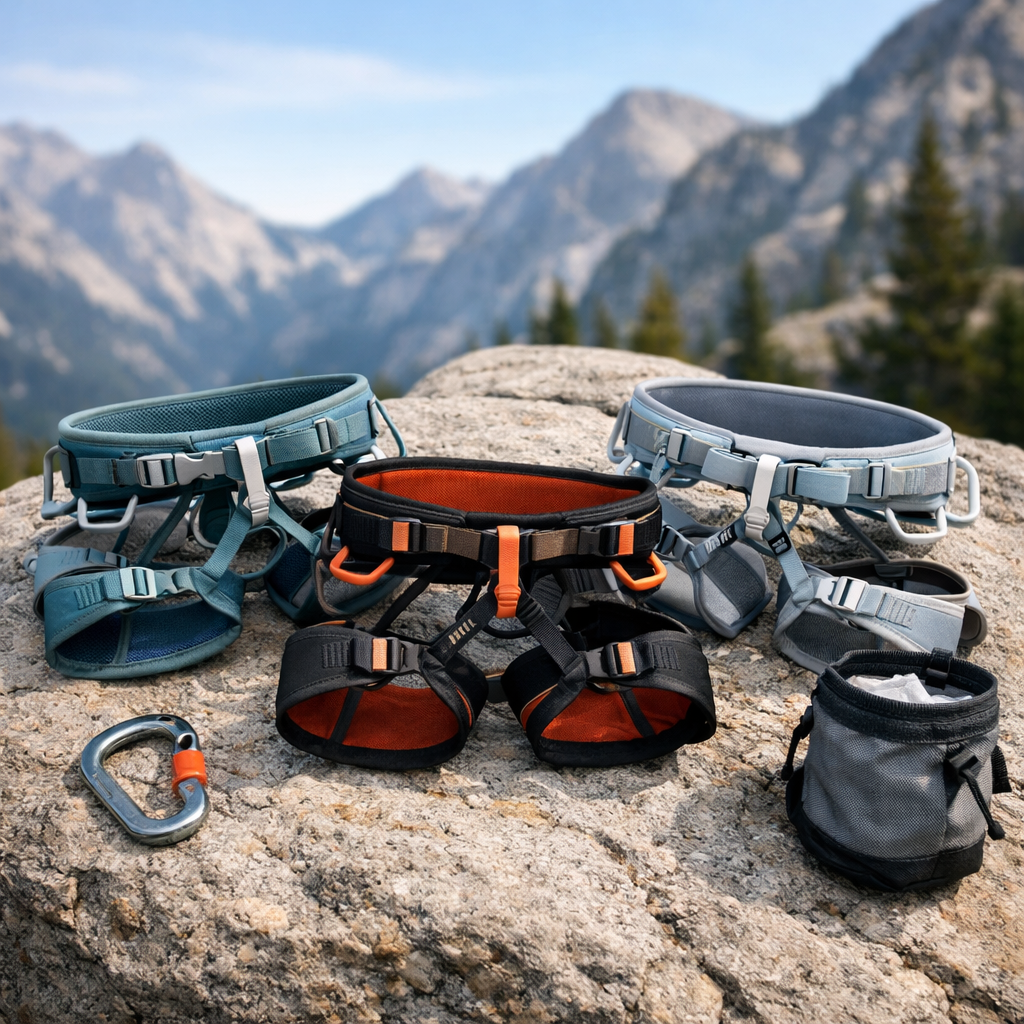
Top Climbing Harnesses This Season, Ranked for Safety and Comfort
Top Climbing Harnesses This Season, Ranked for Safety and Comfort
Finding the right harness means balancing verified safety with all‑day comfort in your exact climbing context. Below, we rank the top climbing harnesses this season for safety and comfort across sport, trad, multi‑pitch, and alpine, drawing on lab benchmarks, field time, and community feedback. If you want a durable all‑rounder, the Black Diamond Solution Guide leads for supportive comfort; for featherweight efficiency, the Petzl Sitta and Blue Ice Choucas Pro shine in alpine terrain. We also outline fit checks, sizing tips, and durability inspections so you buy once and climb confidently. Our picks and advice synthesize current test data and market trends from independent reviews such as Climbing’s 2025 harness roundup, Outdoor Life’s comparative testing, and Switchback Travel’s long‑term guides to deliver a concise climbing harness guide you can act on.
Hiking Manual
At Hiking Manual, our mission is simple: match gear to the user, route, and season. We prioritize function, fit, and real-world performance over spec sheets, and we test with the same lens we bring to our backpack and shelter coverage—comfort under load, durability, weather readiness, and the trade‑offs that actually matter. It’s the same framework we apply when recommending hiking packs like the Maelstrom 40L, IGOLUMON 40L, and TETON Scout 55L, or tents such as the OneTigris COSMITTO and Forceatt 2–3P, and utility vests from LISUHEPEAL and Gihuo—always choosing the right tool for the job, body type, and trip length. This climbing harness guide complements our best climbing harnesses coverage with a function‑ and fit‑first approach, sharpened by real‑world testing and a focus on harness fit for safety and comfort.
How we ranked safety and comfort
We evaluated each harness across disciplines with weighted factors that reflect how climbers actually use them:
- Tie-in/belay loop construction and bar‑tack quality
- Reinforced wear points and edge binding durability
- Haul‑loop rating and utility
- Fall/hang comfort and lumbar support
- Mobility and leg‑loop freedom
- Gear‑loop layout, rigidity, and capacity
- Adjustability (waist/legs) and sizing range
- Weight and packability
For general‑use recommendations, Hiking Manual weights hang comfort and long‑term durability slightly above marginal weight savings.
Belay loop: The primary load‑bearing loop connecting the belay device to the harness. Certified belay loops meet CE/UIAA standards and are designed for repeated loading; signs of fuzzing, cuts, or core exposure indicate retirement.
The market continues to trade grams for plushness and longevity—ultralights excel in mobility but usually offer less padding and faster wear than midweight workhorses, a theme echoed in Climbing’s 2025 harness roundup (weight vs. comfort), Switchback Travel’s season picks, and a candid Mountain Project community thread on the 2025 harness market. For grounding, Mammut’s Sender registers at 11.3 oz and earns praise for hang comfort in Climbing’s tests, while Blue Ice’s Choucas Pro weighs a verified 150 g (5.3 oz) with four gear loops and a rear haul loop in Outdoor Life’s testing.
Comparison snapshot
| Harness | Weight (M) | Key strengths | Leg-loop style | Gear loops | Ideal use |
|---|---|---|---|---|---|
| Black Diamond Solution Guide | 15.6 oz | Support, durability, hang comfort | Fixed | 4 + haul | All‑around trad, long cragging days |
| Petzl Sitta | ~9 oz | Ultralight, sleek, high mobility | Fixed | 4 + haul | Fast multi‑pitch, alpine rock |
| Blue Ice Choucas Pro | 5.3 oz (150 g) | Superlight, alpine features | Fixed | 4 + haul | Technical alpine, glacier travel |
| Arc’teryx AR‑395a | ~13–14 oz | Plush padding, stable hangs | Adjustable | 4 + haul | Projecting, gym/sport |
| Mammut Sender | 11.3 oz | Breathable, comfy hang | Adjustable | 4 + haul | Mixed gym/sport/trad |
| Blue Ice Cuesta Adjust | 10.9 oz | Light, adjustable, value | Adjustable | 4 + haul | Redpoint, travel |
| Ocun Twist Tech Eco | 14 oz (M/L) | Eco build, comfortable | Adjustable | 4 + haul | Gym‑to‑crag generalist |
| Black Diamond Momentum | ~10.7 oz | Stable, budget, beginner‑friendly | Adjustable | 4 + haul | First harness, all‑purpose |
| Black Diamond airNET | 8.3 oz | Ultralight, comp/sport focus | Fixed | 4 (minimal) | Sends, comps, light & fast |
Notes: Weights vary by size; confirm haul‑loop ratings per manufacturer.
What to know before you buy
- Fit in your intended layers, then do a proper hang test: sit for 2–3 minutes to check pressure points, rise height, and leg‑loop comfort. Community testers repeatedly emphasize adjustability for sharing gear and spanning seasons in a frank Mountain Project thread.
- Match harness to discipline:
- Sport/redpoint: low mass, high mobility, minimal bulk.
- Trad/multi‑pitch: reinforced wear points, full‑strength haul loop, ample/rigid gear loops, stable lumbar support. These criteria align with Climbing’s 2025 harness roundup and Outdoor Life’s feature evaluations.
Full‑strength haul loop: A rear loop rated to carry a tagline or small load. Not all haul loops are full‑strength; check the manufacturer’s rating before hauling.
1. Black Diamond Solution Guide
Updated into top lists in late 2025, the Solution Guide pairs contoured hip support with durable fabrics at 15.6 oz and sizes S–XL (men) and XS–XL (women). Climbing’s 2025 harness roundup notes its supportive, hang‑friendly feel, though some testers flagged gear‑loop layout quirks for massive trad racks.
- Best for: all‑around trad, long cragging days, and patient belays where comfort builds focus.
- Pros: stable lumbar support; burly face fabric; balanced rigidity in loops; confidence when hanging.
- Cons: heavier than ultralights; rear loop access can feel busy; overkill for pure onsight sprinting.
- Skip if: you’re an ultralight‑first redpointer needing max mobility and minimal bulk.
2. Petzl Sitta
A specialist for moving fast on multi‑pitch and alpine rock, the Sitta’s sleek build and low weight favor long leads, quick transitions, and clean racking. Treeline Review’s comparative tests highlight its minimalist profile and occasional fiddliness with bulky gloves or crampons—trade‑offs typical of gram‑counting designs.
- Use it for: alpine rock, long ridge traverses, onsight attempts where efficiency and mobility trump plush padding.
- Buying tip: pair with a streamlined rack; if you routinely carry a heavy cam set, consider a more supportive, gear‑forward harness.
3. Blue Ice Choucas Pro
Outdoor Life’s harness testing measured the Choucas Pro at 150 g (5.3 oz) with four gear loops, a haul loop, a self‑locking buckle, and non‑adjustable leg loops—an impressive feature set for true alpine objectives. It excels on glaciers, ski‑mountaineering linkups, and fast technical rock where every gram counts.
- Layering note: non‑adjustable legs demand careful pant/long‑john pairing in winter.
- Caution: racking heavy cams or prolonged hanging comfort lags behind midweight trad options.
4. Arc’teryx AR-395a
Testers repeatedly call out the AR‑395a for comfortable long hangs and repeated falls—exactly what you want while projecting. Outdoor Life’s evaluations point to its broad waistband, stable load distribution, and supportive padding that keeps pressure off sensitive hips.
- Ideal for: gym projecting, sport crag days, and work‑sessions with frequent dogging.
- Fit tip: confirm gear‑loop stiffness for easy clipping with fat sport draws.
5. Mammut Sender
Climbing’s 2025 roundup lists the Sender at 11.3 oz (medium) and praises its hang comfort. Treeline Review notes its breathable build—nylon/elastane with laser‑cut mesh—that vents heat while maintaining midweight stability.
- Quirk: some climbers find rear gear‑loop access awkward; rack high‑use pieces on front loops.
- Best for: mixed gym/sport/trad users who want comfort and ventilation without going full ultralight.
6. Blue Ice Cuesta Adjust
A compelling value for redpoint days, the Cuesta Adjust comes in around 10.9 oz with the adjustability many sport climbers want. Climbing’s tests call it affordable and nearly as light as top ultralights, with a note that rear gear can slide back and hard points are lighter‑duty.
- Strengths: low weight, solid price, travel‑friendly packability.
- Caveats: monitor wear at tie‑in points; chalk‑bag attachment and accessory options are limited.
7. Ocun Twist Tech Eco
The Twist Tech Eco balances comfort with sustainability—about 14 oz (men’s M/L) and 13.4 oz (women’s M/L)—and serves gym‑to‑crag generalists. Climbing’s 2025 coverage praises its comfort but flags a comparatively flimsy‑feeling belay loop relative to peers.
Eco harness: A model that uses recycled or lower‑impact materials/processes to reduce environmental footprint without compromising required safety certifications.
- Use case: eco‑forward buyers with moderate loads who will inspect the belay loop regularly.
8. Black Diamond Momentum and airNET
Switchback Travel’s harness guide spotlights the BD Momentum as a budget‑friendly workhorse (~$65 street, ~10.7 oz) with stable, structured gear loops that help beginners stay organized, while the airNET (~8.3 oz) targets experienced climbers chasing ultralight sends with a stripped feature set.
| Model | Who it’s for | Standout features | Primary caveats |
|---|---|---|---|
| Black Diamond Momentum | New climbers, budget buyers | Stable frame, easy adjustability, durable for price | Heavier, bulkier; not the comfiest for long hangs |
| Black Diamond airNET | Weight‑focused sport/comp climbers | Extremely light, minimal bulk, fast movement | Sparse padding; limited versatility for trad/multi‑pitch |
How to match a harness to your climbing style
- Identify primary use (gym/sport/trad/multi‑pitch/alpine).
- Choose leg‑loop style: fixed for mobility and lighter weight vs. adjustable for layering and shared use.
- Prioritize gear‑loop capacity vs. weight: big trad racks need rigid, roomy loops; sport needs fewer, cleaner loops.
- Confirm comfort in a 2–3 minute hang; no hot spots, stable belay loop, and clean front‑center alignment.
Example mappings:
- Fast‑and‑light alpine: Petzl Sitta; Blue Ice Choucas Pro.
- All‑around trad/multi‑pitch: Black Diamond Solution Guide; Mammut Sender.
- Redpoint/projecting: Arc’teryx AR‑395a; value‑lightweight option: Blue Ice Cuesta Adjust.
Adjustable leg loops: Buckled leg straps that vary circumference for layering or fit differences. They add versatility across seasons and shared use; fixed loops save weight and can increase mobility.
Fit and sizing tips for real-world comfort
- Try on with intended layers. The waistband should center on the iliac crest; you should fit two flat fingers under the belt. Leg loops: snug without pinching. Then do a sit/stand hang test for 2–3 minutes.
- Adjustment range matters: Outdoor Life’s testing notes the Petzl Aquila provides roughly 11 in (28 cm) of waist and 6 in (15 cm) of leg adjustment—useful for diverse body types and seasonal layering.
- Brand variance is real: as noted in Climbing’s 2025 roundup, models like the Petzl Luna run small at the top of their size range (e.g., ~36" waist, ~26" legs in XL). Check charts before ordering.
Durability and safety checks that matter
- Inspect tie‑in hard points and the belay loop for fuzzing, glazing, cuts, or any core exposure; ultralight hard points wear faster—some testers even add protective tape in high‑abrasion zones.
- Check bar‑tacks at gear loops/haul loop and all load‑bearing seams; verify your haul‑loop rating before hauling a tagline.
- Retire after any severe fall with visible damage, chemical exposure, or at the manufacturer’s stated lifespan—whichever comes first.
Hard points: The upper/lower tie‑in areas where the rope threads through the harness. These wear quickly from rope abrasion and should be checked frequently for fraying or color change that reveals internal fibers.
Value picks and when to spend more
- Budget/Beginner: Black Diamond Momentum—structured loops, fair price, durable workhorse per Switchback Travel’s long‑term notes.
- Midweight comfort: Mammut Sender—breathable, hang‑comfort standout highlighted by Climbing’s tests and Treeline Review’s material breakdown.
- Premium/light: Petzl Sitta or Blue Ice Choucas Pro when grams and alpine efficiency matter, consistent with Outdoor Life’s alpine focus and GearJunkie’s ultralight picks.
Spend more if you hang/belay for long periods, carry big trad racks, or need alpine‑rated minimalism. Save if you mostly gym climb, value simplicity, or are sizing kids/teens who’ll outgrow a harness quickly.
Frequently asked questions
How should a climbing harness fit for safety and comfort?
The waistband should sit above your hip bones, snug but not restrictive, and you should be able to hang comfortably without hot spots; leg loops should admit two fingers and the belay loop should center at the front. Hiking Manual uses this hang‑first fit check in all our testing.
Are lightweight harnesses as safe as heavier models?
Yes—reputable lightweight harnesses meet the same CE/UIAA certifications; you trade some padding and durability. In Hiking Manual testing, hard points typically wear faster and hang comfort is lower than on midweights.
What certifications should I look for on a harness?
Look for CE and UIAA markings that indicate standardized strength and safety tests of critical components. Hiking Manual recommends verifying these on the tag or product page.
When should I replace my harness?
Retire it if you see frayed tie‑in points, a damaged belay loop, compromised stitching, or after chemical exposure or a severe fall. Otherwise follow the manufacturer’s lifespan guidance and err on the side of caution—our practice at Hiking Manual.
Can one harness work for gym, sport, trad, and alpine?
One versatile model can span styles, but you’ll compromise; frequent alpine or big trad days push different needs. Hiking Manual suggests choosing based on your primary use.