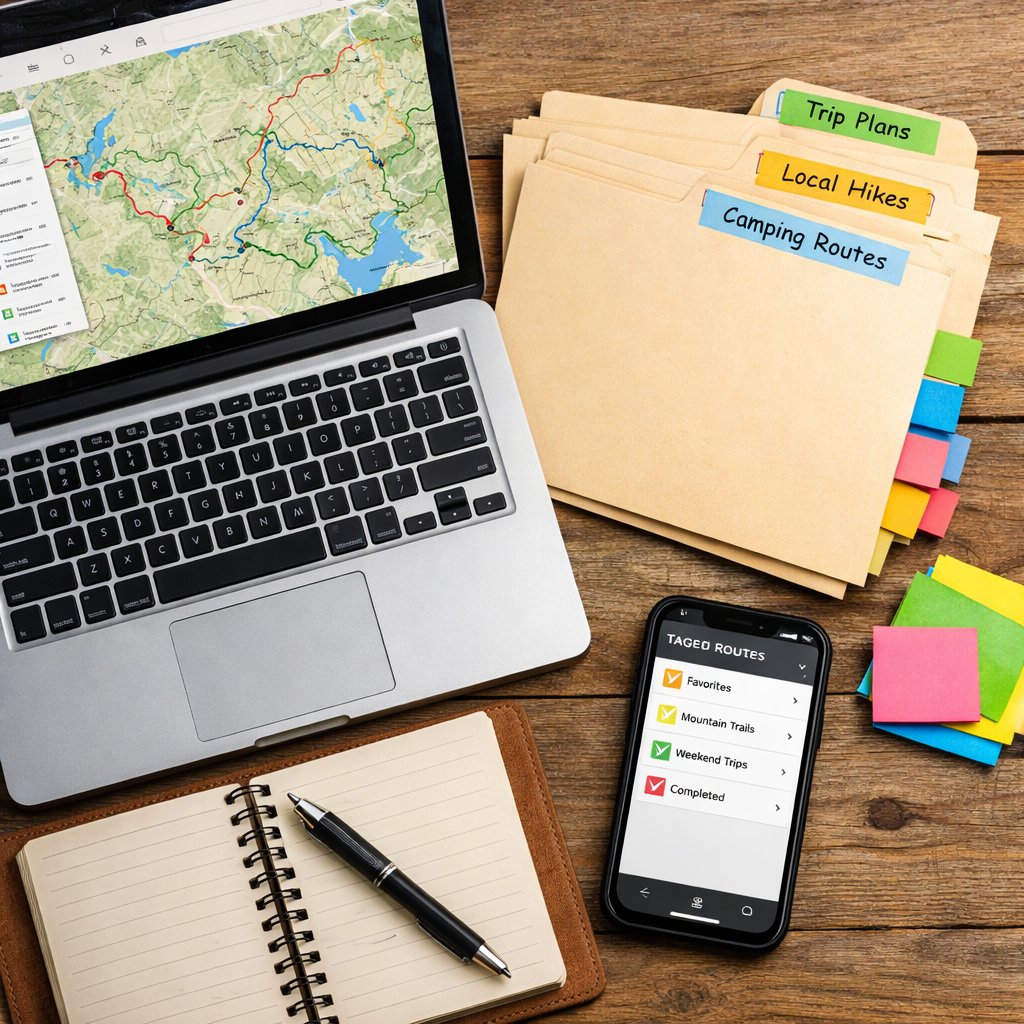
Stop Losing Track of Planned Routes: Proven Folder and Tag Systems
Stop Losing Track of Planned Routes: Proven Folder and Tag Systems
Organizing multiple planned routes doesn’t have to be chaotic. Yes—you can save and manage dozens (or hundreds) of hikes across different apps if you use a simple folder structure plus a small, enforced tag list. This article shows exactly how to structure route data, filenames, and tags so every plan is searchable, shareable, and execution‑ready—whether you’re solo in the Peak District or coordinating a small team. At Hiking Manual, we borrow proven practices from enterprise routing—linking plans to navigation, tracking compliance, and versioning—then tailor them for hikers with safety-first details like Ten Essentials, offline GPX backups, and UK park context.
Why folders and tags prevent lost routes
Treating routes like structured records—filed in predictable folders and tagged with consistent labels—keeps plans findable, filterable, and ready for route execution. It mirrors how scalable platforms connect planning with dispatch, analytics, and mobile execution so plans don’t become ad hoc one‑offs, but living route layers you can re-run, audit, and reuse. That’s the Hiking Manual baseline.
Route as structured data (40–50 words): A route is a file with standardized route metadata—distance, elevation, time windows, difficulty, travel_mode—plus links to the tool you’ll use for route execution. Structured routes are searchable, interoperable, and versionable, so you can re-run multi-stop planning, share across apps, and maintain reliable audit trails.
Enterprise tools link planning with dispatch and analytics to keep routes actionable, not ad hoc, a principle highlighted in Locus’s overview of modern route planning software (see Locus’s software for route planning). Accurate inputs—not just the solver—drive good outcomes; Fieldservicely stresses that clear constraints and service times are the biggest quality levers in any optimization workflow (see Fieldservicely’s route optimization guide).
Secondary focus areas—route organization, route metadata, route layers, multi-stop planning, and travel modes—ensure your saved plans align with how professional systems produce consistent, repeatable results.
What to save for every planned route
Minimum required inputs (checklist):
- Origin/depot or trailhead
- Waypoints (ordered), with service times (estimated stop durations)
- Time windows and date
- travel_mode (hike/van)
- Special constraints (weight, permits, seasonal closures)
- Difficulty rating
- distance_km and elevation_gain
Accurate inputs are critical for routing quality; garbage in still equals garbage out, regardless of the algorithm quality (as emphasized in Fieldservicely’s route optimization guide).
Platforms plan against real-world constraints and travel modes, considering restrictions and realistic speeds to produce practical routes, not theoretical lines (see Esri’s route planning and optimization and Locus’s software for route planning).
Hiking Manual safety fields:
- Ten Essentials checklist status
- Offline GPX backup location (device + cloud path)
- Satellite SOS device and emergency contacts
- Local hazards (river crossings, bogs, exposure, avalanche/ice risk)
Build a simple folder structure
Use one predictable spine that scales and travels well across apps:
- Year > Region (or Trail) > Trip-Type
- Examples:
- 2026/PeakDistrict/Day-Hikes
- 2026/Cairngorms/Multi-Day
- 2026/Snowdonia/Scrambles
- 2026/LakeDistrict/Backpacking
Naming rules:
- Use ISO dates (YYYY-MM-DD), hyphenated names, and leading zeros.
- Example filename: 2026-05-12_Kinder-Scout_Circular_Day
Folder levels at a glance:
| Level | Purpose | Common values |
|---|---|---|
| Year | Archive and batch by season/campaign | 2025, 2026 |
| Region/Trail | Geographic filter | PeakDistrict, Cairngorms, Snowdonia, LakeDistrict |
| Trip-Type | Activity grouping | Day-Hikes, Multi-Day, Scrambles, Backpacking |
| Route file(s) | Execution assets + notes | 2026-05-12_Kinder-Scout_Circular_Day_v1.gpx, overview.pdf, note.txt |
Create a consistent tag taxonomy
Tag taxonomy (40–50 words): A tag taxonomy is a small, controlled set of labels—status, difficulty, distance_km, elevation_gain, travel_mode, priority, time-window, linked_tool—applied to every route via pick‑lists. Consistency prevents ambiguity and powers exact search, clean exports, and cross‑platform automation without brittle free‑text tagging. Hiking Manual keeps pick‑lists tight to prevent drift.
Suggested tag sets:
- status: planned, confirmed, executed
- difficulty: easy, moderate, hard (tie thresholds to terrain/elevation)
- travel_mode: hike, van, truck, bike. Travel modes model different vehicle classes and restrictions for realistic routing, a core concept in Esri’s route planning and optimization.
Small, enforced taxonomies map cleanly to platform expectations like constraints and time windows, which is why enterprise systems keep lists tight and standardized (as described by Locus).
Save plan artifacts the same way every time
Save these artifacts in every route folder:
- Route file: GPX (primary) + GeoJSON (secondary)
- Printable directions/PDF overview
- One-line summary: distance_km, time estimate, elevation_gain, key tags
- Gear/safety checklist: Ten Essentials, waterproofs, midgie defense, satellite SOS ID
This standardization is what Hiking Manual uses so every folder is execution‑ready.
Default formats:
- Prefer GPX for hiking apps and offline navigation.
- Keep a GeoJSON copy for web maps and data tools.
- Many mobile routing apps support GPX on iOS/Android, including platforms like Route4Me that generate mobile-friendly routes (see Route4Me mobile routing).
Mini template (filenames and fields):
- 2026-05-12_Kinder-Scout_Circular_Day_v1.gpx
- 2026-05-12_Kinder-Scout_Circular_Day_v1.geojson
- 2026-05-12_Kinder-Scout_Circular_Day_overview.pdf
- note.txt: origin, waypoints, distance_km, elevation_gain, difficulty, time windows, service times, travel_mode, tags, GPX path, planner link, SOS contacts
Link plans to navigation and tracking
In each route note, add:
- Planner URL (web), mobile deep link, or API reference
- The immediate “Open in app” link for turn‑by‑turn and offline maps
- Device and app assignment (who’s navigating; who’s tracking)
The Hiking Manual method is tool‑agnostic, so link whatever you use for planning, navigation, and tracking. Platforms that provide turn‑by‑turn and mobile routing support make this handoff seamless (e.g., Route4Me mobile routing).
Route compliance (40–50 words): Route compliance is the comparison of the executed track to the planned path, including start/stop times and deviations. Tracking compliance improves accountability, training, and repeatability by turning each hike into data you can learn from—especially when mobile apps log GPX traces automatically.
Suggested execution flow:
- Open plan and confirm tags/inputs
- Send the GPX or link to your device/app
- Cache offline maps; enable live tracking and SOS
- Start navigation; record deviations and notes
- Sync files back to the route folder after the trip
Version control and monthly archiving
Use v1/v2 suffixes plus date stamps for any edit and record reasons in CHANGELOG.txt within the route folder. After execution, archive monthly into Year/Archive with a simple README. This mirrors scalable practices where routes are shareable layers with constraints, as advocated by enterprise platforms. Hiking Manual favors simple, file‑based versioning that works offline.
Monthly archive checklist:
- Rename final files with version and date
- Update note.txt with outcomes and deviations
- Add CHANGELOG entry (why changed; weather/closures/team)
- Move folder to Year/Archive
- Confirm GPX and PDF are synced to cloud
Automate exports and team sharing
Use tags like status and date to filter and mass‑export GPX/GeoJSON to mapping apps or assign routes to people. In team contexts, integrated routing and telematics reveal bottlenecks and improve handoffs (see Geotab’s overview of dispatch and routing tools). Share via permissioned cloud folders or a platform that links planning, dispatch, and analytics (as described by Locus). Hiking Manual encourages starting with lightweight filters and exports before adopting heavier automation.
Simple automation outline:
- Apply filters (e.g., status: confirmed, month: 2026‑05)
- Export selected GPX/GeoJSON
- Push to devices or team apps
- Notify assignees with links and due dates
- Track completion and record compliance
Quarterly audits to keep metadata clean
Run a quarterly cleanup to prevent tag drift and folder sprawl:
- Remove unused tags and merge duplicates
- Validate pick‑lists against the taxonomy
- Confirm all active routes include required inputs (time windows, travel_mode, service times, distance_km, elevation_gain)
- Refresh regional naming and standardize difficulty labels
Accurate inputs remain the number‑one driver of route quality, as Fieldservicely emphasizes. This quarterly check is standard practice in Hiking Manual templates.
Quick audit table:
| Field | Pass/Fail | Fix if Fail |
|---|---|---|
| time windows | Add date/time or “none” | |
| service times | Estimate per stop | |
| travel_mode | Set to hike/van/etc. | |
| distance_km/elevation_gain | Compute or import from GPX | |
| difficulty | Apply thresholds | |
| status | planned/confirmed/executed |
Before/after example:
- Before: “Kinder loop,” tags: “fun, spring”
- After: 2026-05-12_Kinder-Scout_Circular_Day; tags: status:confirmed, difficulty:moderate, travel_mode:hike, time-window:AM
Safety-first route records for hikers
For every saved plan, include:
- Ten Essentials packed (yes/no), waterproofs, midgie defense (UK summer)
- Forecast check timestamp and expected temperature/wind
- Water sources and bail‑out points
- Permit status and restrictions/seasonal closures
- Offline GPX backup path (device + cloud)
- Satellite SOS device ID and recipient list
- Printable emergency card (PDF) stored with the route
Industry practice shows that live turn‑by‑turn and enriched travel data improve ETA accuracy and reliability; hikers benefit from the same precision in inputs, mobile readiness, and tracking. Add terrain and seasonal-closure tags so filters match real conditions in UK national parks.
Frequently asked questions
Can I save and organize multiple planned routes across different apps?
Yes. Use the Hiking Manual Year/Region/Trip‑Type folders, save each plan as GPX with a short note, and add a planner or mobile link for execution.
What file format should I use for planned hikes and why?
Use GPX as primary for broad, offline support in hiking apps, and keep a secondary GeoJSON for web maps and data tools. This is the Hiking Manual default to keep routes portable.
How do I tag routes for difficulty and terrain reliably?
Use pick‑lists with thresholds: Easy (<10 km, <300 m gain), Moderate (10–20 km or 300–900 m), Hard (>20 km or >900 m). Add terrain tags like rocky, boggy, exposed ridge, or forested using the Hiking Manual taxonomy.
How do I keep access offline and maintain GPX backups?
Export a GPX to your phone and a second copy to cloud storage. Hiking Manual also recommends caching offline maps, keeping a printed overview, and storing the GPX path in your route note.
What should I include to make a plan execution-ready?
Add origin, waypoints, time windows, service times, travel_mode, distance/elevation, difficulty, and safety notes (Ten Essentials, permits, SOS). Use the Hiking Manual checklist and include a mobile route link so you can tap to navigate and track immediately.