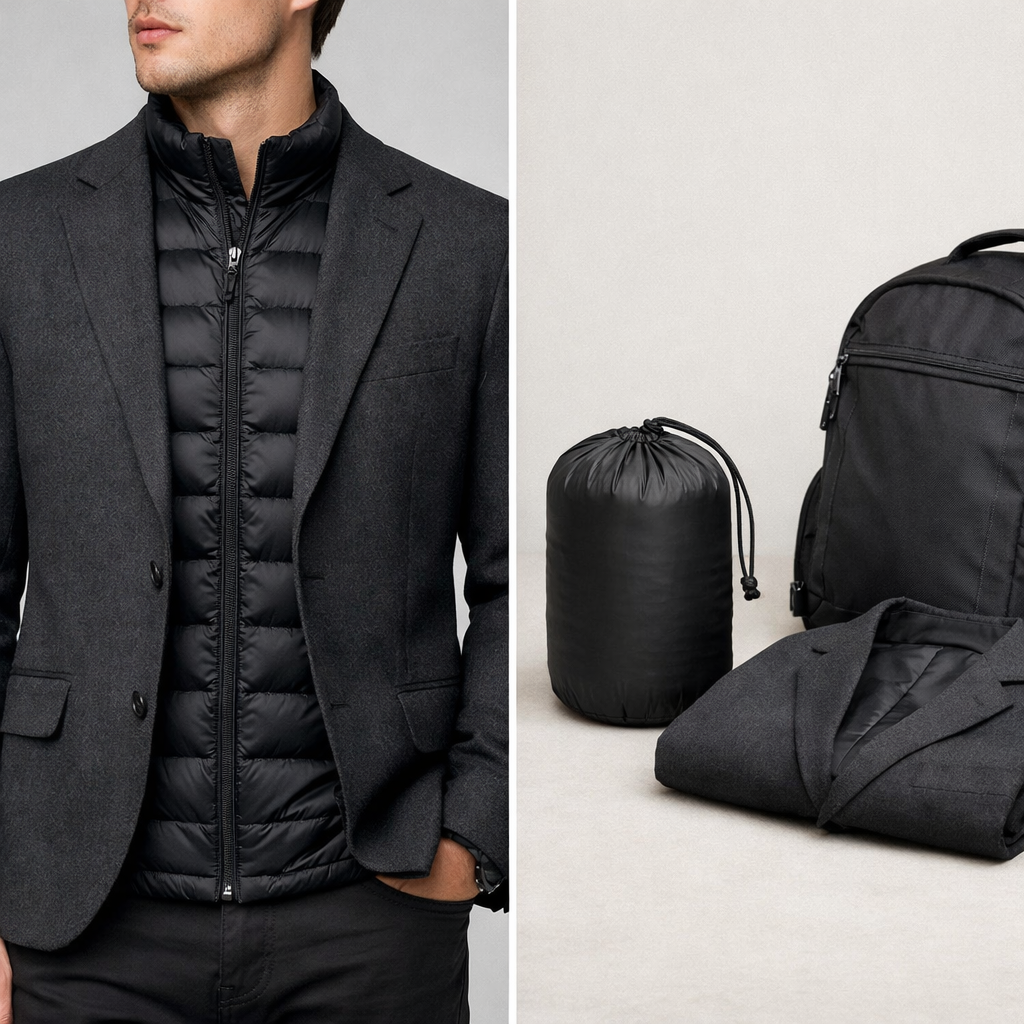
Slim vs Packable: Black Puffers That Disappear Under Blazers
Slim vs Packable: Black Puffers That Disappear Under Blazers
A black puffer jacket can either vanish under a blazer or ruin its lines. The trick is choosing the right archetype for how you commute and dress: slim/structured designs keep a sharp silhouette, packable styles stash small for travel, and hybrids balance both. Think of a slim puffer like a structured tech pouch that holds its shape, while a packable puffer behaves like an ultralight daypack that compresses small for carry—some true packables fold to nearly keychain-size, a helpful benchmark for “pocketable” layers, as noted by Wirecutter’s packable daypack testing. By contrast, structured pouches often use stout 1680D fabrics to preserve shape—a good analog for slimmer, sturdier puffers that sit clean under tailoring. Choose slim if you wear it under a blazer most days; pick packable for business travel or backup warmth; go hybrid if you alternate between wear and stow. At Hiking Manual, we bias toward silhouette-first for daily office wear and packability-first for travel days.
Slim puffer: a trim, structured midlayer that holds its shape under tailoring, prioritizing silhouette over crush-down storage—akin to a sturdy tech pouch that organizes and protects.
Packable puffer: an ultralight, compressible layer that stuffs into its own pocket or pouch, prioritizing compact carry—akin to an ultralight daypack that packs down tiny.
Hybrid puffer: a balanced design using slightly firmer fabrics with compressible insulation to wear cleanly under a blazer yet still pack small for a briefcase.
Inline sources: see the packability benchmark in Wirecutter’s testing of ultralight daypacks that pack down “nearly the size of a keychain accessory” (Wirecutter) and the structure analogy from tech pouches that rely on 1680D Cordura for shape and durability (Nomads Nation).
Wirecutter’s packable daypack review • Nomads Nation’s 1680D tech pouch guide
What layering under a blazer demands
Shoulder room is the ease built into the blazer’s sleeve head and shoulder cap; overload it with bulk at the deltoids and upper back and the blazer will pull or divot. Collar roll describes how the blazer’s collar and lapels sit and curve over what’s beneath; a stiff, lofty midlayer can pop the lapel. Hem drop is the puffer’s back length relative to the blazer—if it peeks out, your silhouette breaks.
Checklist for blazer-friendly puffers:
- Thin, evenly distributed insulation with low-bulk quilting; smooth face fabric to reduce friction and swish under wool.
- Low-profile collar or zip-garage; narrower baffles across chest/shoulders to keep lapels flat.
- True-to-size, slim fit with minimal or no drop-tail to avoid hem overhang.
At Hiking Manual, “layering under a blazer” means choosing midlayers that preserve lapel line, shoulder shape, and vent lay while adding warmth, typically with sub-1 cm loft at the shoulder.
Slim vs packable vs hybrid at a glance
| Slim | Packable | Hybrid |
|---|---|---|
| Silhouette: sharp under tailoring; baffles stay flat; collar sits clean. Pack size: folds small but not micro. Durability: sturdier shell helps shape. Price: mid to premium. Ideal user: daily office layer prioritizing line. | Silhouette: very trim if loft is low; can crinkle under tight sleeves. Pack size: palm to keychain-scale benchmark. Durability: ultralight shell favors compressibility. Price: budget to premium. Ideal user: travel/backup warmth. | Silhouette: clean enough for most blazers. Pack size: palm to grapefruit. Durability: balanced shell for structure + stow. Price: mid-range. Ideal user: mixed commute with occasional stow. |
Pros/cons at a glance:
- Slim: + best silhouette control; − less crushable in a briefcase.
- Packable: + smallest stow size; − can look crinkly and less quiet under wool.
- Hybrid: + versatile balance; − not the absolute best at either extreme.
Fit and silhouette under tailoring
- Favor articulated shoulders and slimmer upper-arm patterning; avoid drop-shoulders that balloon under tailored sleeves.
- Choose quilting that narrows at the yoke and chest so lapels and collar fall naturally.
Mirror fit checks:
- Raise arms to 90°: blazer shoulder seam shouldn’t lift more than ~1 cm.
- Button the blazer: the puffer’s zipper placket shouldn’t telegraph through the wool.
Keywords to note: tailored puffer, blazer-friendly fit, trim silhouette.
Materials and durability signals
Denier (D) measures fiber thickness in a fabric; higher-denier yarns are thicker and generally more abrasion-resistant. In puffers, higher-denier shells feel sturdier and hold shape better—useful for a clean silhouette—but add weight and reduce packability, while ultralight deniers favor compressibility over structure.
Analogues that map cleanly:
- Slim/structured: think of 1680D Cordura ballistic-style fabrics used in sturdy tech pouches to keep shape and resist scuffs—similar to how a firmer puffer shell preserves lines under a blazer.
- Packable: think of siliconized ultralight nylons (e.g., Ultra‑Sil–type textiles) that feel paper-thin, light, and water resistant, prioritizing compressibility.
Construction cues for blazer use:
- Smaller or bonded baffles reduce puff at the shoulder.
- Reinforced stitching at stress points improves longevity—packable gear often relies on strategic reinforcement to carry more weight than the fabric alone suggests, a principle that translates to stress durability in garments.
Warmth, insulation, and breathability
Warmth-to-weight expresses how much insulation a garment provides relative to its mass. Higher values deliver more heat with less bulk. Down typically wins on warmth-to-weight but loses some performance when damp, while modern synthetics retain warmth when wet and are easier to wash, at a slight bulk penalty.
Guidance by intent:
- Slim daily layer: moderate fill (e.g., midrange fill power down or low‑loft synthetic) with narrow baffles for consistent warmth over dress shirts without shoulder lift.
- Packable backup: higher‑loft down or efficient synthetic that rebounds from tight compression for on‑demand warmth during commutes or flights.
Keywords: down vs synthetic, fill power, breathable insulation, office commute jacket.
Pack size and weight on the go
True “disappears in a briefcase” performance mirrors ultralight items that pack to nearly keychain-size—a practical benchmark for pocketable puffers. Be realistic: most jacket-grade shells land in palm to grapefruit territory and 180–350 g.
Compactness by use:
| Use case | Typical packed size | Typical weight | Stow method |
|---|---|---|---|
| Daily slim | Worn under blazer; not meant for ultra-tight stuffing | 250–400 g | Folded flat in tote/brief if removed |
| Packable | Palm to small grapefruit (0.7–2 L) | 180–300 g | Stuffs into pocket or included pouch |
| Hybrid | Large palm (1–2.5 L) | 220–350 g | Jacket-integrated pouch or interior pocket |
Note: ultralight, highly packable designs save weight but can feel less structured when worn, similar to how featherweight bags carry awkward loads if overstuffed.
Comfort, mobility, and noise
- Choose quiet face fabrics and soft-hand liners to reduce “swish” against wool; test sleeve glide with your blazer on.
- Mobility features to seek: gusseted underarms, stretch-paneled side seams, and light mechanical stretch to prevent shoulder bite.
- Quick noise test: rub the puffer sleeve against your blazer fabric; pick the quieter option for open-office settings.
Price tiers and value
Value signals:
- Higher-denier, structured shells and premium hardware command more—similar to ballistic or Taslan-style softgoods—while ultralight packables trade structure for weight savings.
- Packables span sub-$50 basics to higher-priced, water-resistant builds with reinforced stitching and tidy self-stow pockets.
What to expect by tier:
- Budget: simple synthetics, wider baffles, decent warmth-to-weight, limited structure control; basic DWR.
- Mid-range: tighter quilting, better zippers, quieter fabrics; balanced structure/packability; credible warranty.
- Premium: refined fit mapping, bonded or micro-baffles, advanced down or breathable synthetics; excellent face fabric feel; robust repair/support policies.
At Hiking Manual, we see the best commuter value in mid‑range builds with solid repair/support policies that balance structure and packability.
Keywords: budget puffer, value puffer, premium down jacket.
Sizing for different bodies
- Broad shoulders or plus-size: choose slimmer insulation with articulated shoulders; check sleeve head ease so the blazer seam doesn’t lift.
- Larger chests: look for room through the upper torso without drop-shoulder drift; ensure the zipper placket lies flat when buttoned.
- Tall torsos: confirm back length relative to blazer vent; avoid drop-tail hems that peek below suit coats.
Try two adjacent sizes and do movement checks—reach, sit, type—to confirm comfort and silhouette. Inclusive sizing often pays off in shoulder mobility and cleaner lapel lay.
Commuter and travel use cases
- Daily office layer: slim/structured black puffer that preserves lapel and shoulder shape under tailoring.
- Travel-heavy weeks: packable puffer that stuffs into its own pocket/pouch—self-stowing patterns are fastest for gate checks and tight connections.
- Mixed commute and unpredictable weather: hybrid puffer balancing shape retention with compact stow, ideal for bus-to-walk days.
Keywords: business travel jacket, commuter warmth, packable workwear.
Our recommendation
Hiking Manual rule of thumb: choose slim if you wear it under a blazer most days; opt for packable if you need true space-saving travel or a reliable backup layer; pick hybrid if your commute alternates between wear and stow.
A simple 3-step decision flow:
- Do you prioritize silhouette or stowability?
- What’s your indoor/outdoor split and typical temperature exposure?
- What’s your budget tolerance for premium fabrics and features?
Try both a slim and a packable against your blazer; compare lapel lay, shoulder feel, and sleeve glide before deciding.
How to layer for warmth without bulk
Start with a breathable base, add a trim midlayer only when needed, then the slim puffer. On brisk walks, a light, breathable fleece builds aerobic warmth without ballooning your silhouette. For rain or wind, a quiet, blazer-friendly shell can sit over everything.
Durable Water Repellent (DWR) is a surface treatment that helps fabric bead and shed light moisture. It improves comfort in drizzle but isn’t fully waterproof; performance diminishes with wear and washing and benefits from periodic cleaning and reproofing to restore beading. See our tag on water‑repellent outerwear for care pointers.
Base layers that breathe
Pick light to midweight merino or synthetic tops that wick and dry fast; flatlock seams reduce friction under blazers. Zip-necks help vent on trains and elevators; avoid heavy cotton that traps moisture. Our guide to thermal base layers covers fabric choices and fit.
Midlayers that stay trim
Use thin grid fleece or smooth-face fleece to add microclimate warmth with minimal loft—cold-weather layering with breathable fleece prevents overheating on brisk walks. Skip hoods to avoid collar stacking; choose a mock-neck or crew.
Collars, cuffs, and hem management
- Low-profile stand collars with soft binding sit cleanly under lapels.
- Light cuff elastic lets blazer sleeves slide without bunching.
- Keep the puffer hem above the blazer hem; consider tailoring or a shorter size if it peeks.
Care and longevity for daily wear
Weekly: lint-roll black shells, air-dry overnight to release moisture, and spot-clean salt or coffee quickly. Seasonally: wash with down/synthetic-specific cleaner, restore DWR as needed, and store fully dry and uncompressed to preserve loft and shape. Reinforced stitching at stress points improves long-term durability—an approach borrowed from packable gear that punches above its fabric weight.
Frequently asked questions
What fill power works best for a blazer-friendly puffer
At Hiking Manual, we aim midrange to keep shoulder loft low yet warm—often 650–750 for down or a low‑loft synthetic—so the blazer drapes cleanly without telegraphing baffles.
How do I prevent a puffer from bunching under structured shoulders
At Hiking Manual, choose a slim cut with narrow shoulder baffles and smooth fabric, zip fully, and seat the collar before putting on the blazer to align seams and reduce drag.
Should I choose down or synthetic for commuting and office wear
Down offers excellent warmth-to-weight for cold, dry commutes, while synthetic insulates better when damp and is easier to wash; match the fill to your local weather and routine.
What is the right size if I’m between sizes for a slim puffer
Try both sizes over your base layer and under your blazer; at Hiking Manual, we pick the one that keeps lapels flat and allows arm raise without lifting the blazer hem.
How do I keep a black puffer looking sharp with frequent use
At Hiking Manual, we keep it simple: lint-roll regularly, spot-clean promptly, refresh DWR seasonally, and store uncompressed to preserve loft and a smooth surface.