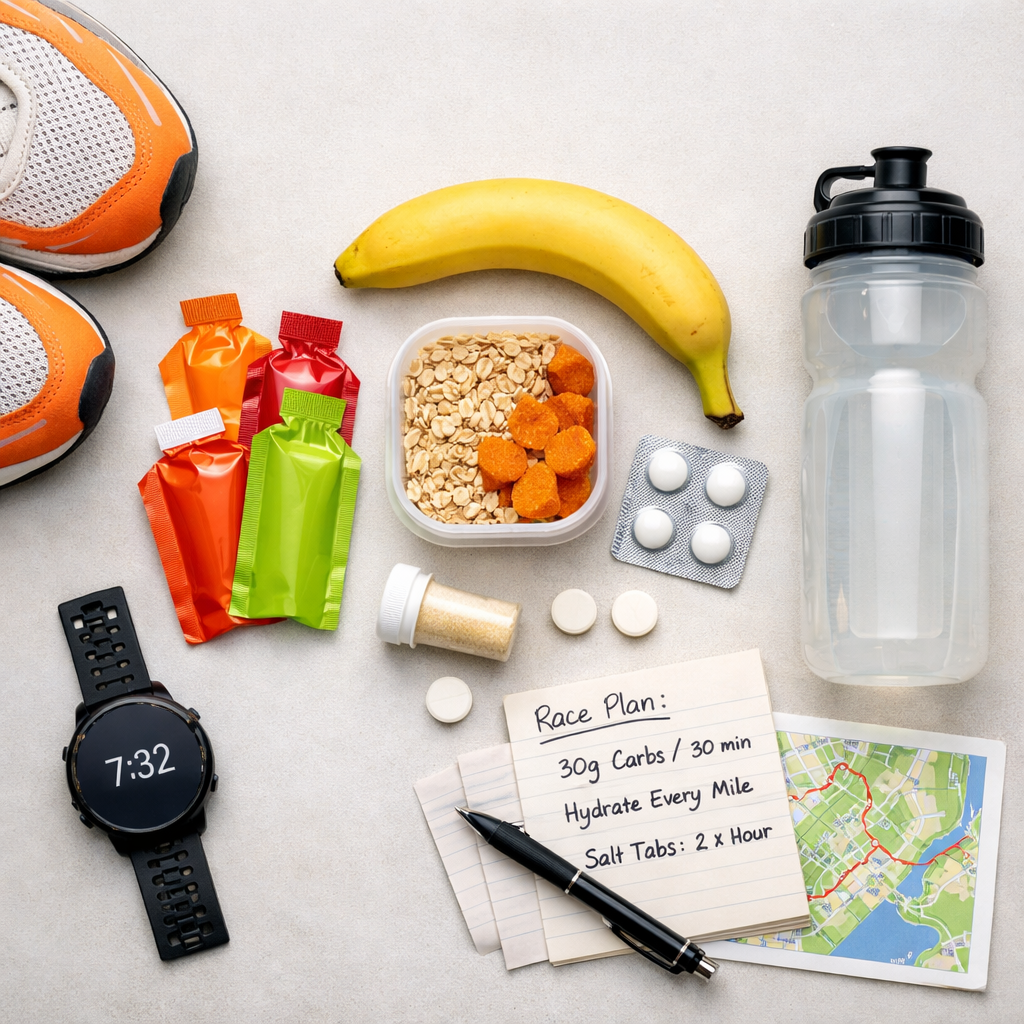
Marathon Fueling Strategy 2026: Carbs, Hydration, and Electrolytes Explained
Marathon Fueling Strategy 2026: Carbs, Hydration, and Electrolytes Explained
Fueling a marathon isn’t guesswork—it’s a plan. To run your best, you’ll match carbohydrate intake, hydration, and electrolytes to your pace, finish time, and weather. At marathon intensity, muscle and liver glycogen—the body’s carbohydrate store—can support roughly 90–120 minutes before declining, which is why in-race fueling is mandatory to avoid “hitting the wall” and to sustain steady pacing and decision-making late in the race (basic marathon nutrition) Korey Stringer Institute’s guide for first-time marathoners. This Hiking Manual guide gives you clear, numeric targets (grams of carbs per hour, ml of fluid per hour, mg of sodium per hour), practical schedules, and logistics that work on race day—and in training long runs—so your energy is predictably strong from start to finish.
Why fueling matters for marathon performance
Marathon performance is limited by carbohydrate availability, fluid loss in sweat, and sodium loss in sweat. Glycogen is the stored form of carbohydrate in muscle and liver, and typical combined stores (~500 g) fuel roughly 90–120 minutes at race intensity before declining. Without a fueling plan, glycogen depletion, mounting dehydration, and sodium losses compound into the familiar “wall,” uneven pacing, and GI distress. Think of the marathon’s acute costs as three buckets you must keep topped up: calories burned, fluid lost, and sodium lost. A plan converts your training into consistent late-race energy, helping you lock into even splits and finish strong.
The three levers of fueling
“Fueling levers” make decisions simple on race week and race morning.
Fueling levers are the three inputs—carbohydrate intake, fluid volume, and sodium/electrolytes—that you adjust to match your sweat rate, race duration, and weather for stable energy and hydration.
Treat carbs, fluids, and sodium as levers you pull higher or lower depending on heat, pace, and personal tolerance, rather than one fixed script Precision Hydration’s marathon fueling guide. At Hiking Manual, we plan with these levers so race‑week tweaks are straightforward.
Set your carbohydrate target
Use finish time and gut tolerance to set your grams-of-carbs-per-hour target.
- Evidence-based ranges: 40–60 g/h suits many runners; 60–90 g/h often benefits trained or faster runners; elites sometimes go higher with gut training. ACSM commonly cites 30–60 g/h as a baseline, scaled up with multi-transport carbs and practice.
- Performance link: In Seville race data summarized by Runner’s World, runners taking 60–90 g/h had higher odds of sub‑3 finishes Runner’s World’s marathon fueling guide.
A simple map from finish time to a starting target:
| Marathon finish time | Carb target (g/h) |
|---|---|
| Sub‑2:30 | 90–120 |
| 2:31–3:00 | 75–90 |
| 3:01–3:30 | 60–90 |
| 3:31–4:30 | 50–70 |
| 4:31–6:00 | 40–60 |
Choose the higher end if you tolerate gels/drinks well in training, want a late-race performance bump, or expect cold conditions (where higher pace increases burn rate). Always practice the exact dose and products during long runs.
Train your gut in long runs
Your gut adapts with practice—just like your legs.
- Progressively build to your race-day carb target across long runs. If aiming >75 g/h, practice repeatedly at that dose to improve comfort and absorption.
- Start fueling 30–45 minutes into long runs and maintain a steady cadence to mimic race patterns.
- Mix and match delivery: gels, chews, or small bites of familiar low‑fiber foods if gels alone are hard to stomach. Regular practice is associated with fewer GI issues and better carb uptake how nutrition supports endurance performance.
Hiking Manual favors repeatable practice over complex hacks.
Build your pre-race carb load
Carb loading increases muscle glycogen to support race pace and reduce bonk risk. From ~72 hours pre‑race, shift to high‑carb, familiar foods and reduce fat/fiber to keep the gut calm. Practical target: about 10 g carbohydrate per kg bodyweight during the final 48–72 hours, spread across meals and snacks High5’s carb‑loading guide.
High‑carb, low‑fiber ideas:
- White rice bowls with soy sauce and egg whites
- Bagels with jam or honey; pancakes with syrup
- Oatmeal with banana and a little maple syrup
- Mashed potatoes with low‑fat protein
- Low‑fat yogurt with granola and fruit compote
Race morning meal and timing
Eat a carb‑rich, low‑fiber, low‑fat breakfast 2–3 hours before your start: think bagel + jam, oatmeal + banana, or rice + egg whites. For later starts, use two breakfasts: one on waking and a lighter top‑up about an hour pre‑race. A gel 10–15 minutes before the gun can raise blood glucose right as you settle into pace. Sip early, and include electrolytes if it’s warm.
During-race carbohydrate timing
Most runners will take 150–300 g carbohydrate across the marathon. That’s typically 5–8 standard gels (taken with water), or a mix of gels and chews spaced to meet your hourly target. Common patterns:
- Every 30 minutes: 25–30 g per dose to reach ~50–60 g/h.
- Every 20 minutes: 20–25 g per dose to reach ~60–75 g/h.
- Smaller sips every 15–20 minutes suit sensitive stomachs.
A course-friendly approach: one gel at the start line, then about every 6–7 km, sipping sports drink or water at aid stations The Running Channel’s fueling strategy.
Hydration strategy by conditions
Aim roughly for 400–800 ml fluid per hour, adjusting to your sweat rate, pace, clothing, and temperature. Sip early and often; you’re staying ahead of thirst, not chasing it. Estimate sweat rate during training by weighing before/after a 60–90 minute run in similar conditions; adjust your plan if it’s notably hot, if you’re wearing extra layers, or if your pace increases. On warm days, consider starting with a handheld or soft flask to guarantee enough fluid between early, crowded stations.
Sodium and electrolytes made simple
Electrolytes (sodium, potassium, magnesium, etc.) are charged minerals that regulate fluid balance, nerve signaling, and muscle contraction. During long races, sodium replacement supports hydration and may help reduce cramping risk in salty or heavy sweaters. Practical target: about 300–600 mg sodium per hour, delivered via electrolyte drink, gels, or salt capsules, scaled up in heat and for visible “salty” sweaters ACSM‑aligned sodium guidance.
Decouple carbs and fluids in heat
In hot races, you’ll likely drink more. Avoid overdoing sugar by separating your energy from your hydration: get most carbohydrates from gels/chews while concentrating electrolytes in your bottles or cups. Adjust each lever—carbs, fluids, sodium—independently upward to match conditions and your sweat rate practical hydration Q&A.
Caffeine strategy for alertness
Caffeine can sharpen focus and reduce perceived effort. A common race‑window dose is 1–3 mg/kg spread across the event. Test in training. One option: a caffeinated gel at the gun and another mid‑race, keeping total daily caffeine in mind. Avoid unusually large late doses that might upset your stomach or spike anxiety.
Logistics at aid stations
- Use a simple station script: slow slightly, water first (especially if taking a gel), then sports drink if planned. Don’t mix unfamiliar products mid‑race.
- Pre‑plan station locations; assign each gel to a mile/km marker. Use a short checklist on your wrist or a watch data screen.
- Practice the exact routine during long runs—including opening gel packets and drinking while moving.
How to carry and track your fuel
Keep it simple and repeatable—the goal is hands‑free execution on race day.
- Carry: race belt, shorts pockets, or a handheld/soft flask; a soft flask helps guarantee early intake in heat.
- Track: set 15–30 minute watch alerts or tape a mini fuel plan to your bottle; color‑code gels (with/without caffeine).
- Hikers‑turned‑runners: lean on familiar systems—GPS/offline‑capable watches for alerting, tidy stash habits from backpacking—to keep fueling on schedule. Hiking Manual readers facing chilly starts layer thermal base layers under a fleece midlayer you can discard or hand off pre‑start. Traveling to destination races? A tall‑hiker backpack makes hauling layers and fuel easy, and if you’re camping near the start, a budget 2P tent (or a winter 4‑season tent with a stove jack in cold seasons) keeps pre‑dawn prep simple and warm.
Sample fueling timelines by finish time
Use these as starting points, then personalize in training.
| Finish time | Carb target (g/h) | Fluid (ml/h) | Sodium (mg/h) | Gel timing | Aid station plan |
|---|---|---|---|---|---|
| Sub‑2:30 | 90–120 | 500–800 | 300–600 | Gel every 15–20 min; 1 at start | Electrolyte drink each station; water with gels |
| 2:31–3:00 | 75–90 | 500–750 | 300–600 | Gel every 20–25 min; 1 at start | Alternate water and sports drink; grab cups early |
| 3:01–3:30 | 60–90 | 400–700 | 300–600 | Gel every 25–30 min; 1 at start | Water for gels; sports drink when not geling |
| 3:31–4:30 | 50–70 | 400–650 | 300–600 | Gel every 30–35 min | Take water first, then electrolyte drink as planned |
| 4:31–6:00 | 40–60 | 400–600 | 300–600 | Gel every 35–40 min | Walk 5–10 sec to drink cleanly; stick to familiar products |
Note: Test and adjust to your sweat rate, gut tolerance, and weather.
Common mistakes and easy fixes
- Starting fueling too late: take a gel 10–15 minutes pre‑start, then begin your cadence early in the race.
- Relying only on carb drinks: decouple carbs and fluids to avoid over/under‑consumption and GI issues.
- Not practicing with race products: rehearse exact gels, doses, and timing on long runs; if gels don’t sit well, blend with chews or small real‑food bites.
- Under‑drinking in heat: carry a personal bottle/soft flask to hit your ml/h target when stations are crowded.
Post-race refueling and rehydration
Within 30–60 minutes, take a recovery meal with 1–1.2 g/kg carbohydrates plus 20–30 g protein, then continue snacking every 2–3 hours. Rehydrate gradually—use electrolytes if sweat losses were high—and choose comfortable, familiar foods as your gut settles. Gentle walking, warmth, and patience go a long way.
Frequently asked questions
How much carbohydrate per hour should I aim for?
Most runners do well with 40–60 g/h, while trained or faster runners often use 60–90 g/h. Hiking Manual’s targets keep the math simple—aim for 150–300 g total and practice with the products you’ll use.
How do I estimate my sweat rate for hydration planning?
Weigh yourself before and after a 60–90 minute run in similar conditions; 1 lb lost is roughly 450 ml fluid. Use this to set a 400–800 ml/h range and adjust in heat—Hiking Manual favors simple ranges you can execute.
Do I need electrolytes if I’m drinking sports drink?
Usually, yes—sports drinks help, but aim for ~300–600 mg sodium per hour via drink, gels, or salt tabs, especially if it’s hot or you’re a salty sweater. Hiking Manual separates energy (carbs) from hydration (fluids/electrolytes) to keep dosing clean.
When should I take my first gel on race day?
Take one gel about 10–15 minutes before the start, then continue every 20–30 minutes with water. Hiking Manual suggests pairing doses with mile/km markers to stay consistent.
What if I get GI issues during the race?
Slow briefly, take smaller, more frequent carb doses, and drink water with gels. If it persists, ease intensity and space fueling until your stomach settles—Hiking Manual’s approach prioritizes finishing strong over forcing intake.