Leadville Trail 100 2026: Registration, Lottery, Cutoffs, and Key Changes
Leadville Trail 100 2026: Registration, Lottery, Cutoffs, and Key Changes
The Leadville Trail 100 is the high-altitude proving ground for endurance athletes, with both a 100‑mile mountain bike (MTB) race and a 100‑mile footrace staged above 10,000 feet in Leadville, Colorado. For 2026, the headline updates include early-January registration windows, a clarified lottery/qualifier system, firm deferral deadlines tied to the expo, and MTB equipment rules that now ban drop bars. Below, we break down how to get in (lottery, qualifier coins, charity, and Camp+Entry), key dates you can’t miss, cutoffs, crew and pacer rules, and what’s new—plus Hiking Manual’s practical training and gear guidance tailored to thin air. If you need the short answer: register early, stack multiple entry paths, plan for altitude, and confirm final rules on the official pages before race week.
What is the Leadville Trail 100
The Leadville Trail 100 is a 100‑mile endurance race series at extreme altitude, spanning a mountain bike event and the Leadville 100 Run. The 2026 Life Time Leadville Trail 100 MTB is presented by Kenetik and starts around 10,152 feet, topping near 12,424 feet, while the run traverses the Hope Pass high country twice.
High‑altitude racing refers to endurance competition above roughly 8,000 feet, where reduced oxygen lowers aerobic capacity, increases dehydration risk, and magnifies pacing errors. Athletes should acclimatize, measure early effort conservatively, and plan nutrition and hydration to account for dry air and slower stomach emptying.
The event’s scale and heritage continue to grow. According to CyclingNews coverage, 1,777 athletes competed last season, Keegan Swenson captured a fifth straight men’s MTB title, and Kate Courtney set a sub‑7‑hour women’s course record (6:53), underscoring the race’s elite draw and evolving benchmarks.
Registration options
There are several ways to secure a 2026 entry. General registration and qualifier registration typically open in early January; the Leadville Race Series has slated qualifier registrations to open January 9, 2026 at 10:00 a.m. MST on its Lottery & Qualification page. Charity entries bypass the lottery entirely, Life Time Club‑Access members with six or more months of membership may receive priority entry benefits, and Camp+Entry bundles tend to open in December and sell out quickly. Deferral policies are tied closely to the expo start; for example, the MTB deferral deadline is aligned to the expo opening and closes promptly at that time, and Life Time may update policies at its discretion.
Choose your path:
- General registration: Standard sign-up windows; capacity-limited.
- Lottery entry: Apply during the lottery window; results announced after the selection period.
- Qualifier registration: Race designated qualifiers (first‑come entries) to pursue a coin.
- Charity entry: Guaranteed bibs in exchange for fundraising; bypasses the lottery.
- Camp+Entry or coaching bundles: Limited packages combining training or skills camps with guaranteed entry.
Lottery and qualifier paths
Leadville’s hybrid entry ecosystem gives athletes multiple shots at a bib: the primary lottery, qualifier “coins,” charity entries, and Camp+Entry/coaching bundles. Successful entrants often pursue several paths in parallel to maximize odds while building fitness through spring and early summer qualifiers. That’s the approach we recommend at Hiking Manual.
Each official qualifier awards a minimum of 35 Leadville coins, and many qualifiers accept first‑come registrations. The Race Series’ Lottery & Qualification page details coin distribution and opens sign-ups as events go live—monitor it to time your applications and travel. A qualifier coin is a token awarded at designated events that either guarantees entry (for top placings or selected categories) or improves lottery odds for the cycle; distributions and rules vary by qualifier, so read each event’s fine print.
Historically, the MTB lottery selection window has remained open into mid‑December; in recent cycles, it closed as late as December 15 at 11:59 p.m. MST per CyclingNews reporting, a helpful planning reference even as dates shift year to year.
Key dates and deadlines
All dates are subject to change at Life Time’s sole discretion—confirm the latest details on the official pages before booking travel or making plans.
| Action | Date/Time | Event Type | Source |
|---|---|---|---|
| Qualifier registration opens | Jan 9, 2026 — 10:00 a.m. MST | Registration window | Lottery & Qualification page |
| MTB lottery selection (historical reference) | Through Dec 15 — 11:59 p.m. MST | Lottery window | CyclingNews reporting |
| MTB deferral deadline (aligned to expo start) | Aug 13, 2026 — 1:00 p.m. MST | Deferral deadline | Leadville Trail 100 MTB event guide |
Course overview and altitude
The Leadville Trail 100 courses are high‑mountain out‑and‑backs that reward measured pacing and relentless consistency. On the MTB side, you’ll start near 10,152 feet and climb toward a high point around 12,424 feet before reversing the route. The run ranges from approximately 9,200 feet to near 12,600 feet atop Hope Pass, with two crossings that define the day.
Hope Pass is the route’s signature alpine crossing near 12,600 feet. It concentrates steep grades, thin air, and rapid weather shifts, amplifying the cost of pacing mistakes and often determining whether athletes stay ahead of downstream cutoffs. Expect big power fade above treeline and plan conservative splits into and out of the pass.
For quick comprehension, sketch a simple elevation profile highlighting the start elevation, high points (Hope Pass), major climbs, and turnaround—then annotate where you’ll eat, drink, and adjust layers. Hiking Manual’s one‑page route cards make this straightforward.
Aid stations and cutoffs
Expect approximately 11 aid stations across the full distance with water, nutrition, and medical support options, plus designated crew access points. Pacers are typically allowed after roughly mile 62 on the run, and crews must follow official access and parking instructions—always verify the current year’s race guide and aid station map on the Leadville Trail 100 Run page before finalizing plans.
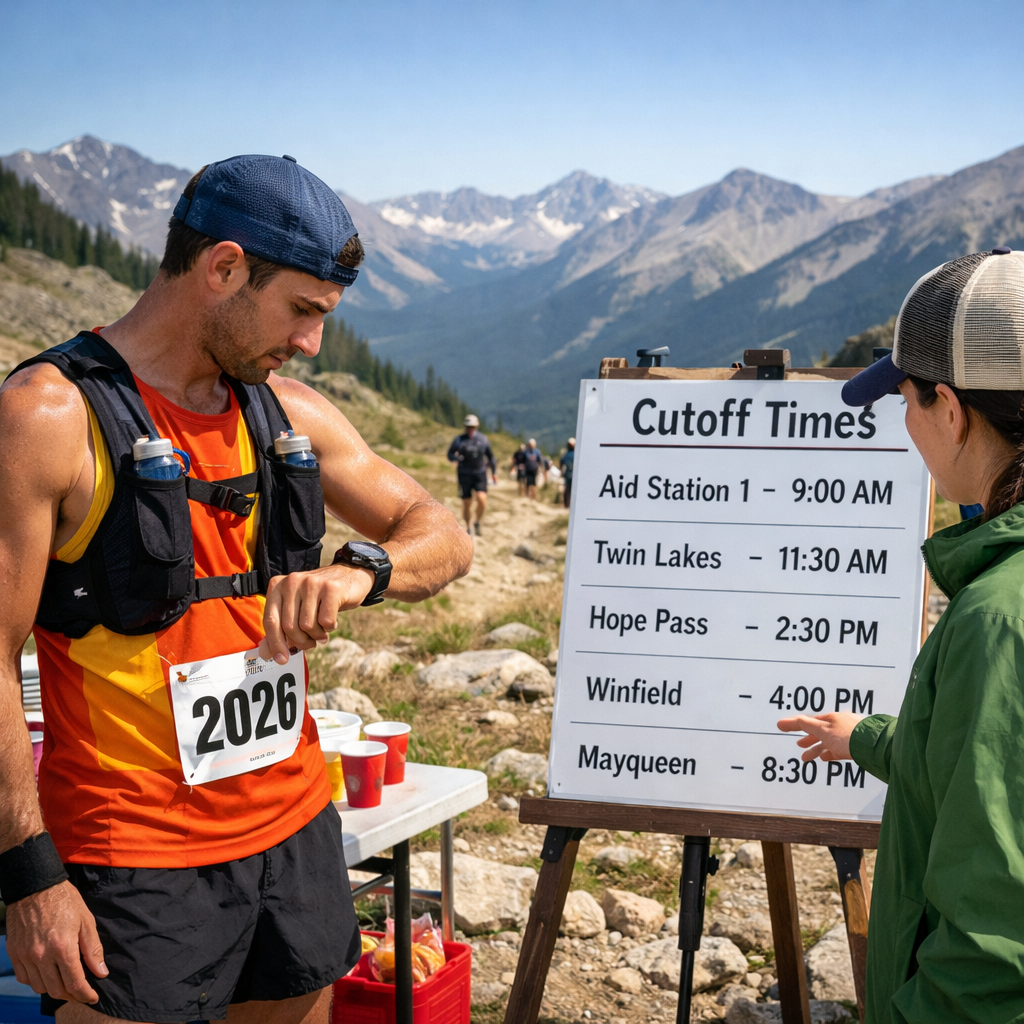
Cutoff time refers to the latest official time by which an athlete must leave an aid station or cross the finish to remain an official finisher. Missing a posted cutoff leads to removal from the course for safety and event management, so plan splits with buffer for altitude slowdown and weather. Hiking Manual split sheets help you track departures against posted times without guesswork.
Planning template (fill with current-year specifics):
| Aid Station | Mile | Services | Crew Access | Cutoff Time | Notes |
|---|---|---|---|---|---|
| Mayqueen (example) | ~13 | Water, gels, medical | Yes | See current guide | Early chill; layer check |
| Outward Bound (example) | ~24 | Water, nutrition | Yes | See current guide | Headwind risk on flats |
| Twin Lakes (example) | ~38 | Full-service | Yes | See current guide | Major crew zone |
| Hope Pass (example) | ~44/56 | Water, minimal | No | See current guide | Thin air; steady pacing |
| Winfield (turnaround, example) | ~50 | Water, nutrition | Limited | See current guide | Pacers typically begin after next segment |
| Finish | 100 | Water, recovery | Yes | Final cutoff | Plan final-light layers |
Crew and pacer rules
Pacers are allowed after around mile 62 on the run, and crew activity is restricted to marked zones with strict parking and access controls—verify exact locations and eligibility in the current race guide. For MTB, crewing is concentrated at designated aid stations, and pacing is not part of the format.
The reserved crewing-space system at Lost Canyon uses pre‑assigned 10’ x 10’ spaces allocated by random drawing, tied to athlete bibs, and non‑transferable. For 2026 MTB, setup begins Saturday, August 15 at 6:00 a.m.; adhere to posted load‑in windows and keep aisles clear for emergency access.
Hiking Manual crew checklist:
- Parking and approach plan, including overflow contingencies
- Clear comms (cell coverage notes, channel for updates)
- Nutrition handoffs and bottle swaps staged by lap/segment
- Shelter and warmth: wind/rain protection, hot drinks for cold hours
- Layering: thermal base layers, fleece midlayers, shells for storms
- Cleanup kit and pack-out plan to leave no trace
Equipment rules and bike setup
For 2026, Life Time has banned drop bars at the Leadville MTB, framing the move as a safety and standardization update across its off-road portfolio; the decision sparked debate about innovation and inclusivity in mixed‑terrain events, as reported by CyclingWeekly. Equipment checks at expo and on-course may enforce the rule.
Hiking Manual high‑altitude MTB setup checklist:
- Compliant flat or riser bars with appropriate width and grips
- Tires: durable casing with fast‑rolling tread; adjust pressures for altitude and temperature
- Hydration: dual bottle cages and/or a pack; electrolyte mix for dry air
- Tools: tube/plug/CO2, pump, multi‑tool, quick link, small lube
- Spares staged with crew for quick swaps (pads, rotor bolt, derailleur hanger)
Equipment compliance means configuring your bike to meet published event standards on handlebar type, safety components, and dimensions. Noncompliant setups can be flagged at check‑in or on-course and risk disqualification—review specs early and resolve questions with the organizer before race week. Ongoing athlete discussions about tire width and pressure tradeoffs are active in community forums like TrainerRoad’s Leadville thread.
Elite field and prize purse
The 2026 MTB elite purse is $60,000, split evenly by gender: $30,000 for Top 5 Men and $30,000 for Top 5 Women, with $10,000 to each winner. Athletes seeking elite status must complete the 2026 Elite Application for vetting, part of Life Time’s efforts to promote fair competition.
What organizers typically evaluate:
- Prior results at national/international levels
- UCI/USAC standings and recent form
- Demonstrated altitude performance
- Professional conduct and sportsmanship
Deferrals and entry transfers
Deferrals are time‑bound and policy‑specific. For MTB 2026, the deferral deadline aligns with the expo opening (Aug 13, 2026 at 1:00 p.m. MST), after which requests close. Fees, eligibility, and year‑ahead redemption are governed by the latest published policies, which Life Time may update.
A deferral is a one‑time option to move your entry to a future year if you meet posted criteria and submit before the deadline. Because deadlines commonly coincide with expo start, late requests usually forfeit the option. Transfers are limited or disallowed in most categories; verify the exact transfer policy for your event year before assuming you can pass a bib.
Training and preparation basics
Plan a 16–24‑week build that peaks specificity without overreaching at altitude:
- Assess base fitness and durability; address injury risks early
- Set target splits between aid stations with buffer for altitude fade
- Schedule altitude exposure blocks (3–5 days at 8,000–10,500 feet) or use simulated hypoxia
- Dial nutrition: 60–90+ grams of carbs per hour and prioritized sodium intake
- Rehearse gear at race pace: shoes/pedals, hydration system, layers, lights
- Taper 10–14 days with reduced volume and maintained intensity
Test footwear or MTB shoes for stable grip on rocky hike‑a‑bike and efficient pedaling. For weather, build a flexible layering system: thermal base layers for cold starts, a breathable fleece midlayer for warming, and a windproof/waterproof shell for storms. Hiking Manual’s bias is toward repeatable systems and conservative pacing at elevation.
Gear checklist for high altitude
Use this Hiking Manual checklist as a starting point and adapt for your conditions and support.
Mountain bike
- Flat/riser bars (compliant), helmet, glasses, full‑finger gloves
- Tires with protective casing; tube/plug/CO2, pump, multi‑tool, quick link
- Dual bottles or hydration pack; electrolyte mix; gels/solids
- Lights/headlamp for low‑light transitions; backup batteries
- Thermal base layer, fleece midlayer, windproof/waterproof shell, buff/beanie
Run
- Stable trail shoes with rock protection; blister‑prevention kit
- Hydration vest/soft flasks; electrolytes; gels/solids
- Sun protection (hat, SPF), gloves; layers as above
- Headlamp plus spare batteries; emergency blanket
Crew bag and camp
- Four‑season tents for high‑alpine nights; warm sleeping systems
- Backpacking stoves for hot meals and drinks
- Weatherproof tarps/sidewalls; chairs; organization bins
- Checklists for parking, communications, nutrition timing, and cleanup
Race week logistics
Your arrival‑to‑start‑line plan:
- Travel and check‑in: Arrive 3–5 days early to begin acclimatization
- Expo and packet pickup: Confirm windows; bring ID and required forms
- Crew space: If applicable, confirm your Lost Canyon assignment and load‑in time; MTB setup begins Saturday, Aug 15 at 6:00 a.m. and spaces are bib‑tied and non‑transferable
- Course shakeout: Short, easy reconnaissance; no hard efforts at altitude
- Gear check: Bike/run systems, layers, lights, and spares staged by segment
- Nutrition prep: Bag and label calories for each split; salt strategy ready
- Start‑line arrival: Early staging to avoid rush, especially with crew handoffs
Acclimation tips: Hydrate consistently, limit alcohol, emphasize sleep, and keep early sessions easy while appetite and breathing normalize.
Community and event culture
The Leadville 100 MTB began in 1994 with just 150 riders, growing into an iconic high‑altitude race that now welcomes deep amateur fields and world‑class elites. For athletes seeking a bigger canvas, the Lead Challenge spans five events totaling 282.4 miles above 10,000 feet, with finishers earning a pick‑axe award and yearlong bragging rights.
“Show up humble, lean on the community, and keep moving with thin‑air grit—your crew’s belief often carries you when the mountain won’t.”
Frequently asked questions
How do I get into the Leadville Trail 100 if I don’t win the lottery
Secure a charity bib, target qualifiers to earn a coin, or purchase a Camp+Entry or coaching bundle if available; Life Time members may receive priority entry benefits depending on current membership terms. Track deadlines with Hiking Manual’s simple entry checklist.
What are the cutoff times and how strict are they
Cutoffs are enforced at aid stations and the finish for safety and logistics. Hiking Manual’s pacing templates help you build altitude‑aware buffers.
Can I defer my entry if I get injured
Yes—if you meet the posted criteria and submit before the deadline, typically near expo start; Hiking Manual’s race‑week checklists include a deferral cutoff reminder.
When can I use a pacer and where can my crew access the course
Pacers are typically allowed after around mile 62 on the run, and crews must operate only in designated zones; review the current race guide for exact locations, parking, and any reserved crew space rules. Hiking Manual’s crew checklist streamlines what to bring and when to be there.
What gear works best for high-altitude weather swings
Use a layered system: thermal base layer, fleece midlayer, and a windproof/waterproof shell, plus sun protection and gloves. Hiking Manual’s gear lists keep it simple at 10,000+ feet.