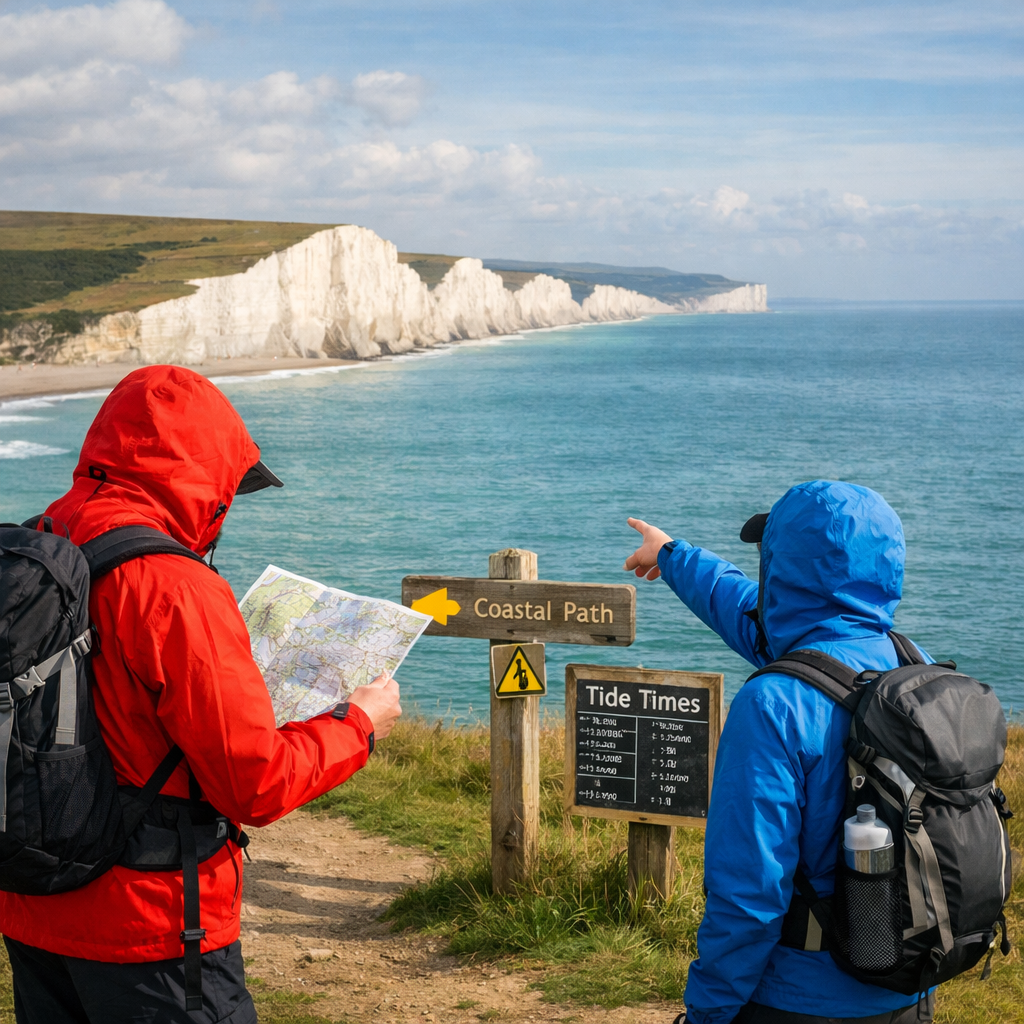
How to Stay Safe on the Seven Sisters Coastal Walk
How to Stay Safe on the Seven Sisters Coastal Walk
The Seven Sisters is one of England’s most spectacular coastal walks—and one of the most exposed. To stay safe, plan your point‑to‑point day from Seaford to Eastbourne, check weather and tide times, keep well back from chalk cliff edges, and know where you can exit if conditions change. The standard route is around 21.2 km/13.2 miles with roughly 513 m of total ascent and takes fit walkers about 6 hours 45 minutes according to a detailed Seven Sisters route guide. It’s not a loop, so sort your finish logistics in advance using Seaford/Eastbourne rail links and coastal buses, or a taxi if needed. With a simple kit, a conservative buffer from edges, and a plan for tides and wind, families and first‑timers can enjoy superb coastal views with confidence. Hiking Manual focuses on simple, proven habits like these so more people finish this route safely.
Know the route and exit points
This is a linear Seaford–Eastbourne day hike, not a loop—plan your end‑point transport before you start, as emphasized in Seaford–Eastbourne planning tips. Expect about 21.2 km/13.2 miles and ~513 m ascent (roughly 6 h 45 min for fit walkers) per the detailed Seven Sisters route guide. Save an offline route map and mark exits to avoid walking beyond your limits; Hiking Manual recommends noting bus stops and taxi numbers before you set off.
An exit point is a safe, known place where you can end or pause your hike and leave the trail—typically a car park, bus stop, village, or visitor hub. Identifying exits in advance helps you avoid overcommitting, adapt to weather or tide, and arrange pickup without backtracking on exposed ground.
Tip: Seven Sisters parking and visitor hubs can be very busy on weekends and Bank Holidays; arrive early and check access/closures ahead of time.
| Location / exit point | What’s there | Transport options | Taxi fallback |
|---|---|---|---|
| Start: Seaford Esplanade or Seaford Station | Seafront start, shops in town | Trains to Seaford; local buses along the coast | Save a local Seaford taxi number before you set off |
| Cuckmere Haven (Seven Sisters Country Park) | Visitor centre area, toilets/café nearby inland; river mouth can be a tidal trap | Regular coastal buses on the A259; onward walking paths inland | East Dean/Seaford taxis can reach the visitor area |
| Birling Gap exit | National Trust café, toilets, seasonal tap; direct access to road | Nearby bus stops and parking; onward paths to East Dean/Eastbourne | Keep a Birling Gap/East Dean taxi contact as backup |
| Finish: Eastbourne (seafront or station) | Full town services | Trains from Eastbourne; numerous buses | Town taxis widely available |
Check weather and tide times
Make a quick pre‑walk ritual: check the day’s forecast and Seven Sisters tide times. Coastal walking safety advice highlights that getting cut off by the tide is a common hazard, and exposed cliff‑top wind and rain can turn minor slips into serious incidents. This route is very exposed; postpone in very windy or rainy conditions, as many walkers note in a first‑hand account of the South Downs exposure. The best weather window is generally May–September, with May–June bringing wildflowers and manageable crowds per the detailed Seven Sisters route guide. At Hiking Manual, our routine is simple: forecast, tides, daylight, and backup transport.
Pre‑walk checklist:
- Forecast and wind speed (postpone in gales or driving rain)
- Tide table (avoid rising tide traps at river mouths and beaches)
- Sunset time (carry a headlamp if finishing late)
- Backup bus times and an offline map
Pack simple safety kit
You don’t need much—just the safety essentials that prevent exposure, dehydration, and poor navigation. Bring a fully charged phone, offline map/GPS, 1–2 L of water, snacks/lunch (food stops are limited on route), suncream, hat/sunglasses, layered clothing, a light waterproof, sturdy footwear, and a small first‑aid kit. Practical Seven Sisters tips note limited facilities on busy days and a water tap at Birling Gap, but queues form—don’t rely on it as your only refill.
Emergency essentials are a compact set of items that help you prevent or manage common hiking problems: communication (phone), navigation (map/GPS), weather protection (layers, waterproof, suncream), hydration and energy (water, snacks), and first aid. This small kit turns typical mishaps—blisters, wrong turns, sudden wind—into manageable inconveniences. Hiking Manual keeps kit lists focused so they’re easy to pack and use.
Tell someone your plan
Share your plan with a trusted contact before you go—a simple habit that speeds help if plans change or phones die, as advised in coastal walking safety guidance. Text an update if you change exits or finish late.
Three‑line template:
- Start/Route: “Seaford → Birling Gap → Eastbourne on the cliffs.”
- Timing: “Start 09:30. ETA Eastbourne 16:45.”
- If overdue: “If I’m >2 hrs late and not in touch, call 999 and ask for the Coastguard.”
Keep clear of cliff edges and bases
Stay well away from cliff edges and the cliff base. Official South Downs cliff safety guidance warns that chalk cliffs can crumble without warning; major falls can happen at any time. Use a conservative rule of at least a 5 m buffer from the edge for personal safety per the detailed Seven Sisters route guide, and add more space in wind or after rain. Slips and falls also happen on smaller drops—treat all edges with caution, as reinforced in coastal walking safety advice.
Chalk cliff collapse is a sudden failure of soft, eroding chalk that forms overhangs and hidden voids. Surfaces can look solid yet give way, dropping debris down the face. That makes both the top edge and the beach directly below hazardous.
Follow signs, fences and marked paths
Respect all signs and fences, even where sections are unfenced—heed any warnings where posted, as noted in a first‑hand account of the South Downs exposure. Staying on marked paths protects fragile chalk grassland and reduces your risk near eroding edges. Try a “STOP” check at viewpoints:
- Stop
- Take two steps back
- Observe your footing
- Photograph from a safe stance
Manage dogs and respect livestock
This is working farmland. Keep dogs on short leads near livestock and cliff edges, bag and bin waste, and avoid disturbing ground‑nesting birds. When passing herds:
- Pass gates calmly; don’t feed livestock
- Give wide space; keep moving steadily
- If animals approach, turn away calmly—do not run
Use safe crossings and avoid tidal traps
At the River Cuckmere, shallow crossings may be possible at safe low tide, but can be impassable or dangerous on a rising tide. If it’s too deep or fast, detour inland to the Cuckmere Inn and use the bridge as described in the detailed Seven Sisters route guide. Coastal walking safety advice is clear: don’t attempt river mouth crossings on a rising tide, and don’t linger at the cliff base on beaches due to rockfall risk highlighted by local authorities.
Pace the ups and downs and plan rest stops
Expect repeated climbs and descents; the first climb from Seaford is the longest and the route is tiring but very achievable for fit walkers, according to a concise route snapshot. Pace steadily on ascents and take short breaks on summits well back from edges. Plan rest/refresh stops at Cuckmere Haven and Birling Gap (toilets, café), but expect queues and limited facilities at busy times.
Simple energy plan:
- Snack every 60–90 minutes
- Sip water regularly
- Add electrolytes in warm, windy weather to avoid late‑walk “bonking”
Dress for wind, sun and sudden showers
There’s virtually no natural shelter on this coast. Wear breathable layers with a windproof/waterproof shell; the same day can feel warm in sun and cold in wind, as many report in a first‑hand account of the South Downs exposure. Apply and reapply suncream; bring sunglasses and a cap. Choose sturdy hiking shoes or boots for support on repeated chalk and grass climbs, a point echoed in practical Seven Sisters tips.
Protect the landscape and archaeology
You’re walking the Sussex Heritage Coast, home to protected archaeology and rare chalk grassland. Staying on marked routes avoids erosion and damage. Chalk grassland can support up to 40 flowering plant species and 20+ butterfly species—another reason to tread lightly, as explained by local authorities. Do not light barbecues or fires in Seven Sisters Country Park.
If trouble starts, call for the Coastguard
Always carry a phone. If you or someone else is in difficulty on cliffs or at sea, call 999 and ask for the Coastguard—local safety campaigns reinforce this guidance. Do not attempt an untrained rescue. Remember “Float to Live”: if caught by waves, lean back, control your breathing, and stay afloat until help arrives. Coastal walking safety advice notes that around half of people who drown on the coast never intended to enter the water.
Budget-friendly gear picks from Hiking Manual
Value gear can boost stability, comfort, and weather protection without overspending. Here are starter‑friendly picks that match this exposed route. For more, see Hiking Manual’s buyer’s guides.
Beginner trekking poles for stability
- Adjustable aluminum poles with secure lever locks for durability at good value
- Ergonomic foam or cork‑style grips for comfort in wind and salt spray
- Sizing tip: elbows near 90° on flat ground; shorten for climbs, lengthen for descents
- See Hiking Manual’s beginner trekking poles guide for fit and setup advice
Comfortable, durable boots for teens and families
- Mid‑height boots or supportive trail shoes with grippy outsoles and toe guards
- Waterproof/breathable membrane for wet grass and passing showers
- Fit tips for teens: room in the toe box, secure heel, moisture‑wicking socks to prevent blisters
- Explore Hiking Manual’s comfortable, durable boots for teens guide
Budget tents and durable options for longer trips
- Budget pick: quick‑pitch, double‑wall tent with aluminum poles for weekend South Downs trips
- Durable pick: proven 3‑season model with robust poles and guying that stands up to coastal winds
- Practical note: no barbecues or open flames in the park; cook only where permitted off‑route
- Compare options in Hiking Manual’s budget tents and durable tents guides
Frequently asked questions
How far back should I stay from the cliff edge?
Hiking Manual recommends keeping at least 5 m from the edge, and more in windy or wet conditions. Chalk cliffs can collapse without warning, so take photos from a conservative distance.
Can I cross the River Cuckmere at the beach?
Only at safe low‑tide conditions and never on a rising tide. If it’s too deep or fast, Hiking Manual advises detouring inland to the Cuckmere Inn bridge rather than risk a crossing.
What should I do if someone falls or is in the water?
Call 999 and ask for the Coastguard. Hiking Manual does not recommend untrained rescues—if you’re caught by waves, remember “Float to Live” until help arrives.
Are dogs allowed and do they need to be on a lead?
Yes—keep dogs on short leads near livestock and cliff edges, and always bag and bin waste to protect wildlife and farmland.
Are barbecues or drones allowed on the cliffs?
Barbecues and fires aren’t allowed in Seven Sisters Country Park, and drone use is restricted—check local rules before flying. Hiking Manual recommends leaving drones at home unless you have explicit permission.