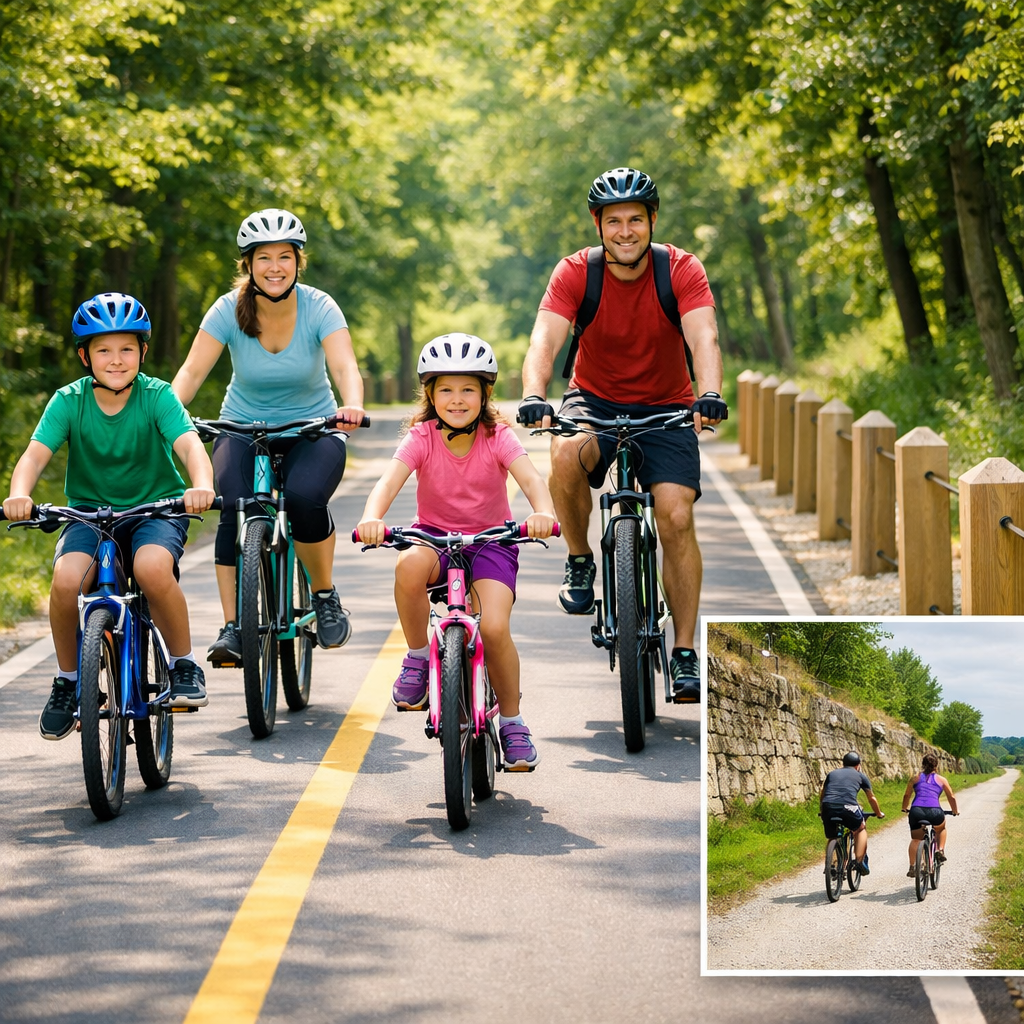
Greenways vs Rail Trails: Choosing Safer Family Cycling Routes
Greenways vs Rail Trails: Choosing Safer Family Cycling Routes
Choosing a safer, low-stress place to ride with kids comes down to separation from traffic, predictable terrain, and reliable maintenance. Both greenways and rail trails can deliver car-free bike paths; the better choice depends on your family’s needs that day. Rail trails usually win for flat, continuous riding that’s friendly to small wheels and trailers. Greenways excel for shade, park access, and nature. This Hiking Manual guide shows how to verify a route is truly family-friendly—surface, crossings, lighting, patrols—and how to plan with phone-based navigation, inclusive gear, and simple checklists so everyone enjoys the ride.
What families mean by safe cycling routes
A safe cycling route for families is a physically separated path with gentle, predictable grades and smooth, consistent surfaces; it has controlled road crossings, good sightlines and lighting, and is backed by regular maintenance and patrol programs. These features correlate with higher use and better safety outcomes in trail research.
What most families prioritize:
- Car-free or minimal car interaction, with marked, controlled crossings
- Gentle grades and smooth surfaces (paved or fine crushed stone)
- Clear signage, line-of-sight, and lighting in busier zones
- Frequent access points, restrooms, water, and shade
- Mobile navigation support with offline maps and recent user reviews
- Multi-use trail etiquette: keep right, pass on the left, alert with a bell/voice, control speed, and leash pets
Definitions and how they differ
Rail trails: Multi-use trails built on abandoned or rail-banked railroad corridors. Because rails required low curvature and steady grades, these conversions typically offer straight alignments, gentle slopes, and continuous rights-of-way that suit strollers, small bikes, trailers, and adaptive cycles, with fewer steep climbs or sharp turns than on-street routes. See the Pennsylvania Greenways and Trails How-To Manual for design context and examples (Creating Connections: The Pennsylvania Greenways and Trails How‑To Manual).
Greenways: Linear corridors of protected open space managed for conservation and recreation. They often follow rivers, ridgelines, or utility easements and may include one or more trails. Beyond recreation, greenways connect parks and neighborhoods, protect habitat, and buffer waterways while offering off-street travel options (Benefits of Trails and Greenways – SJC Parks).
Related terms:
- Rails-with-trails: Shared-use paths that run beside active rail lines (not abandoned), separated by design features detailed in transportation and trail manuals (Creating Connections: The Pennsylvania Greenways and Trails How‑To Manual).
- Towpaths/canal corridors: Historic service ways along canals; today many are integrated as greenway trails.
Shared benefits: Trails and greenways provide low/no-cost places to walk and bike, increase physical activity, and create multimodal links that can replace short car trips (Benefits of Trails – Rails to Trails Conservancy).
Safety criteria that matter for families
Use this checklist to evaluate a route:
- Separation from traffic and controlled crossings: Look for full physical separation from vehicles and crossings with signals, stop controls, refuge islands, good sightlines, and lighting. Research links design/maintenance to favorable safety and crime outcomes.
- Predictable grades and surfaces: Flat-to-gentle grades and uniform surfaces reduce falls and braking stress—especially for kids, cargo bikes, and trailers. Rail-based corridors tend to deliver steady grades and fewer surprises.
- Maintenance quality and visibility: Confirm recent resurfacing, vegetation trimming, drainage, and debris removal. Good visibility around curves, underpasses, and trailheads improves reaction time and comfort.
- Wayfinding and amenities: Clear signage, mile markers, restrooms, water, and shaded rest areas reduce stress and prevent bonks.
- Verify with tools: Check elevation profiles, surface tags, and crossings on trusted maps; read recent user reviews; scan local parks/transport pages for maintenance alerts and patrol/lighting details.
Predictable grade (40–50 words): A predictable grade is a steady, low slope—commonly under a few percent—along a route that minimizes sudden climbs or descents. It reduces shifting and braking, helps new riders maintain balance, lowers fatigue, and preserves traction for trailers and cargo bikes on asphalt or fine crushed stone.
Rail trails
Rail trails shine for family rides because they offer continuous corridors, gentle grades, and generally smoother, uniform surfaces—traits inherited from railroad engineering and highlighted in state trail manuals (Creating Connections: The Pennsylvania Greenways and Trails How‑To Manual). These design qualities support consistent pacing for mixed-ability groups and reduce surprises at corners or hills.
Community investment and upkeep often follow. The Mineral Wells–Weatherford Rail-Trail in Texas, for example, draws roughly 300,000 annual visitors, generating about $2 million in local spending (Economic Impact of Rail Trails – Adventure Cycling Association). Businesses along trails routinely report customers who come specifically to ride and visit, reinforcing maintenance and amenity upgrades (Economic Benefits of Trails and Greenways – Rails to Trails Conservancy).
Safety perceptions are backed by research: across hundreds of rail-trail corridors, conversions of abandoned rail lines to trails are associated with reduced crime when design and maintenance are addressed (Rail-Trail Studies – Bruce Freeman Rail Trail).
Trade-offs to note:
- Exposure: Open alignments may mean less shade; plan sun protection and water.
- Popularity: Expect crowding on marquee segments; choose off-peak times or quieter trailheads.
Greenways
Greenways are protected open-space corridors—often along rivers or through park systems—that balance recreation and conservation. They preserve habitat, connect ecosystems, and buffer streams, improving water quality by filtering runoff; they can also mitigate flood damage in floodplains where FEMA estimates annual property losses exceed $1 billion (Benefits of Trails and Greenways – SJC Parks).
Set expectations before you go: routing may be less direct than rail trails, surfaces and grades can vary by segment, and ownership/management may be fragmented. Those factors aren’t deal-breakers, but families should verify paving status, crossings, and maintenance notes via local agencies. In return, greenways frequently deliver:
- Shade and cooler microclimates along riparian corridors
- Park access, playgrounds, and picnic areas
- Nature viewing and birding opportunities
- Multiple neighborhood access points and loop options
Side‑by‑side comparison for family safety
| Feature | Rail Trails | Greenways |
|---|---|---|
| Origin/context | Converted railroad rights-of-way | Protected open-space corridors (rivers, ridgelines, utilities) |
| Typical grade/surface | Very gentle grades; often paved or fine crushed stone | Variable grades/surfaces; may mix paved and natural segments |
| Continuity/length | Long, continuous corridors with few interruptions | Can be segmented or indirect with more transitions |
| Shade/scenery | Often more open; broad views, less canopy | Frequently shaded; richer habitat and water features |
| Crossings/controls | Fewer crossings; better sightlines due to straight alignments | More frequent crossings; visibility varies by setting |
| Crowding likelihood | High on marquee routes/weekends | Differs by park context; can disperse use via multiple access points |
| Amenities (restrooms, parks) | Trailheads spaced along corridor; amenities vary by town | Strong park integration with restrooms, play areas, water |
| Maintenance/patrol norms | Often well-maintained where tourism/economic benefits are recognized | Varies by agency/segment; confirm local maintenance and patrols |
Based on state trail design guidance for rail corridors, greenway conservation and floodplain functions, and studies linking maintenance and patrols to safer outcomes.
Which to choose for common family scenarios
- First ride with a balance bike or trailer: Choose a nearby rail trail for low grade, smooth surface, and continuity.
- Hot summer afternoon: Opt for a shaded greenway section near parks and water.
- Mixed-ability group with grandparents and kids: Pick a rail trail for predictable pacing and frequent trailheads.
- Nature-forward outing or birding: Select greenway segments that buffer streams and connect habitats.
Quick decision flow:
- Prioritize car-free separation from traffic.
- Check surface and grade for your bikes and abilities.
- Confirm crossings, lighting, and patrols.
- Choose amenities (restrooms, shade) and right-sized distance.
Planning tools and route‑finding tips
- Start with Hiking Manual’s family route checklist, then use TrailLink, a national trail database with surfaces, photos, and user reports maintained by the Rails-to-Trails Conservancy (TrailLink).
- Cross-check local parks and transportation department pages for maintenance alerts, paving updates, lighting, and patrol details. Public health agencies and cities promote trails to boost activity—an indicator of support and upkeep.
Step-by-step checklist:
- Filter for paved or crushed stone and review the elevation profile.
- Identify crossings and trailheads; confirm restrooms, water, and shade.
- Download offline maps and the latest user reviews; bring a backup battery.
- Save an alternate shorter turnaround in case energy or weather shifts.
Gear and setup for low‑stress family rides
Hiking Manual’s packing lists help you keep essentials light and organized.
- Go packable: lightweight rain shells, breathable midlayers, and a quick-setup sun/rain shelter for trailheads or turnarounds.
- Bike fit and carrying: dial saddle height; consider trailers, cargo bikes, or child seats; confirm hitch compatibility. Choose wide tires (40–50 mm on gravel) for stability on crushed stone.
- Essentials packing list:
- Helmets, front/rear lights, bell
- Spare tube, tire levers, mini-pump/multi-tool
- Basic first-aid kit and high-visibility layers
- Snacks, water, sunscreen, bug spray
- Phone navigation with offline maps and a power bank
Accessibility and inclusive ride considerations
- Surfaces and widths: Rail trails’ smoother surfaces and predictable grades typically support wheelchairs, strollers, handcycles, and other adaptive cycles; confirm width and surface type in advance.
- Fit and comfort: Adjustable saddles and stems help plus-size and tall riders; breathable apparel and wider saddles increase comfort. Do a short trial near accessible parking before a longer commit.
- Features to check: ADA-friendly trailheads, curb cuts, benches/rest areas, shade, water, and restrooms.
Recommendations and next steps
Default to rail trails when you want predictable, low-grade, continuous routes with kids; choose greenways for shaded, scenic, park-linked rides and conservation value. In both cases, verify surface, crossings, lighting/visibility, and maintenance or patrols before you go.
Plan a pilot outing this week:
- Pick a 3–8 mile out-and-back on paved or fine crushed stone.
- Ride during low-crowd windows and set a fun turnaround snack stop.
- Save the route offline and share your ETA with a friend.
Remember the wider benefits worth supporting: trails bring customers to local businesses, connect everyday trips, and improve air quality and habitat (Benefits of Trails – Rails to Trails Conservancy; Economic Benefits of Trails and Greenways – Rails to Trails Conservancy; Benefits of Greenways – Greenways.com).
Frequently asked questions
Are rail trails safer for young or new riders than greenways?
Often yes: rail trails usually have gentler grades and smoother, continuous surfaces that help beginners balance and reduce braking; well-maintained greenways can be equally safe—use Hiking Manual’s route checklist to confirm paving, crossings, and lighting.
What surface is best for kids’ bikes, trailers, and cargo bikes?
Paved asphalt or fine crushed stone is ideal. Hiking Manual’s gear guides explain tire choices for trailers and cargo bikes.
How far should we plan to ride with children of different ages?
Start small: 2–4 miles for preschoolers on balance bikes, 4–8 miles for grade-school riders, and adjust for heat, hills, and breaks. Plan an out-and-back with a motivating midpoint like a playground or snack stop; Hiking Manual’s planning tips help you right-size distance.
How do I verify a route is traffic‑free and well maintained?
Filter for off-street multi-use paths on trusted maps, read recent user reviews, and check local parks pages for maintenance alerts; Hiking Manual’s route checklist covers surface, crossings, lighting, and patrol notes to confirm before you go.
What safety features should I look for at crossings and trailheads?
Look for marked crossings with clear sightlines, signals or stop controls, lighting, and refuge islands, and for trailheads with parking, restrooms, water, maps, and emergency contact info; Hiking Manual’s pre-ride checklist keeps these top of mind.