Best Yoga Poses for Tight Hips: Evidence-Based Relief Guide
Best Yoga Poses for Tight Hips: Evidence-Based Relief Guide
Tight hips show up on the trail and at the desk as tugging lower backs, cranky knees, and short strides. The best yoga poses for tight hips blend gentle warm-ups with targeted openers and a quiet finish: think Low Lunge and Lizard for hip flexors and adductors, Figure Four or Pigeon for external rotators, and a restorative hold like Supported Bridge to seal in ease. This concise, evidence-informed guide gives beginner-friendly options, smart props, and 10-minute micro-sessions you can repeat anywhere for real relief.
Hiking Manual
This is Hiking Manual’s practical blueprint for beginner–intermediate hikers and desk-bound readers who want a simple, budget-friendly hip mobility routine. We prioritize tight hip flexors relief, a steady hip mobility routine, and beginner yoga for tight hips with clear progressions, yin yoga for hips, and restorative hip stretches. Short micro-sessions (5–15 minutes) boost consistency and make practice achievable for busy schedules, a leading trend in 2025 wellness habits (Trimurti Yoga, Top 7 Trends) (evidence on micro-sessions). The broader yoga landscape is also becoming more inclusive and beginner-forward, with greater use of props and chair variations (YogaRenew, 2025) (inclusive, prop-supported trend). For trail comfort beyond the mat, see our take on breathable footwear for long days outside (best breathable hiking shoes). We filter choices through a hiker’s lens—efficient, repeatable, and easy to do before or after miles.
Why hips get tight and what to target
Sitting, high hiking or running volume, and limited movement variety shorten tissues and narrow ranges of motion. Key players to address: hip flexors (front of hip), adductors (inner thigh), external rotators (deep glutes/piriformis), hamstrings, and gluteals. Expect gradual gains in mobility (control through range) alongside flexibility (range itself), not overnight changes.
Definition: Hip flexors are the muscle group at the front of the hip (including psoas and rectus femoris) that lifts the thigh; when shortened by prolonged sitting, they limit extension and can tug on the lumbar spine, contributing to stiffness and discomfort.
Longer, quiet holds (Yin Yoga) are effective for releasing tight hips and easing the lower back (Yoga Journal’s most-read practice guidance) (yin for hips and low back). Interest and access are high: more than 34 million people in the U.S. practiced yoga in 2023 (yoga participation data), and restorative/Yin rank among top choices for stress relief in 2025 trend reports.
How to use this guide
- Hiking Manual’s simple formula: pick 1–2 dynamic warm-ups, 2–3 targeted openers, and finish with 1 restorative hold.
- Warm-up anchors: Sun Salutations (Mountain → Forward Fold → Plank → Cobra → Down Dog) build heat and link breath to movement (Vikasa, Spring 2025) (why salutations work).
- Scale and succeed: Props (blocks, straps, chairs, blankets) make poses safer and more accessible for all bodies—lean on them early and often (YogaRenew, 2025).
Pigeon Pose
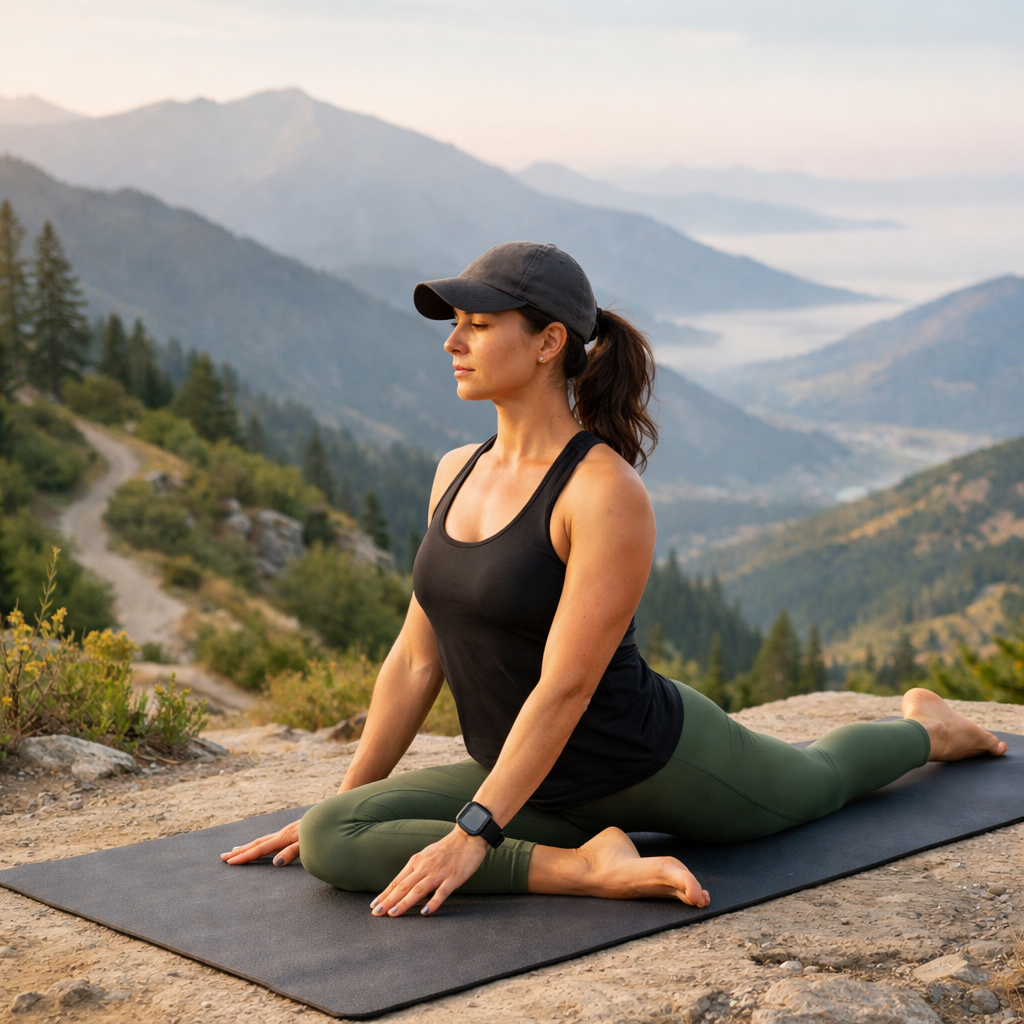
Pigeon Pose (Eka Pada Rajakapotasana) is a deep external-rotation hip stretch that targets the gluteals and posterior capsule while lengthening the back-leg hip flexors; it’s potent; protect the knees and sacroiliac joint.
How to:
- From Down Dog, step right knee toward right wrist; angle shin forward to tolerance.
- Slide left leg straight back, top of foot down; square hips as best you can.
- Prop: place a folded blanket/bolster under the front hip for level support.
- Fold forward on forearms or a block; breathe 30–90 seconds.
- Knee-friendly swap: Reclined Figure Four.
Photo cue: front shin angled comfortably, back leg long, pelvis evenly supported. For deeper alignment detail, Jason Crandell’s pose notebooks offer excellent pointers (Jason Yoga Pigeon guide).
Low Lunge
Opens the front of the hip (hip flexors) and resets posture after sitting.
How to:
- From a lunge, place front knee over ankle; drop back knee and pad it if needed.
- Sink hips forward and slightly down while keeping ribs stacked over pelvis.
- Hands on blocks to keep spine long; avoid collapsing into the low back.
- Options: gentle pulses with breath or hold 30–60 seconds per side.
These alignment cues mirror widely taught basics (Yoga with Kassandra) (low lunge form and flows).
Lizard Pose
Bridges lunges to Pigeon, loading the adductors and anterior hip.
How to:
- From Low Lunge, bring both hands inside the front foot.
- Step front foot slightly wider; toes and knee track the same line.
- Stay on hands, forearms, or forearms on blocks; option to lower back knee.
- Take 5–10 active breaths before settling for 30–60 seconds.
- If groin is sensitive, reduce depth and keep back knee down.
Three Legged Dog and Downward Dog
Use these as dynamic integrators to heat tissues and sync breath.
- Downward-Facing Dog lengthens hamstrings and calves, decompresses the spine, and opens the shoulders while engaging legs and arms (Vikasa) (see link above).
- Three-Legged Dog adds a deep front-of-thigh and hip opening; bend the lifted knee and draw hip circles to mobilize (Yoga with Kassandra) (see link above).
- Warm-up ideas: pedal the knees, slow hip circles, and flow through Sun Salutation components.
Seated Forward Fold and Supported Forward Fold
Balance hip openers with posterior-chain release and a calmer nervous system.
- Seated Forward Fold: hinge from hips with a long spine; strap around feet if hamstrings are tight; bolster under knees for comfort. It both releases hamstrings and soothes the back (Vikasa) (see link above).
- Supported Forward Fold: rest forearms/head on stacked blocks or a chair; this variation reliably calms and refreshes the legs (The Healthy, expert guidance) (why supported folds soothe).
- Office-friendly: chair-assisted versions are ideal during breaks, and chair yoga is growing in popularity (Yogic Escape, 2025) (chair yoga trend and options).
Butterfly and Bound Angle
Bound Angle (Baddha Konasana) brings the soles of the feet together to gently open the inner hips and adductors—beginner-friendly and highly prop-adaptable.
Options:
- Upright with a tall spine and hands behind for support.
- Fold forward with elbows lightly on shins (avoid pressing knees).
- Reclined with blocks or bolsters under knees for longer, passive holds.
- Yin-style durations (2–5+ minutes) are especially effective for hips and lower back (Yoga Journal) (see link above).
Happy Baby
A soothing finisher that releases posterior hips and relaxes the lower back.
How to:
- On your back, grab shins or outer feet; knees wide toward armpits.
- Keep tail heavy and spine neutral; gentle rocking is optional.
- Straps looped over feet help if mobility is limited.
- Hold 45–90 seconds with slow, nasal breathing.
Garland Squat
Functional mobility for hikers—hips, ankles, and adductors.
How to:
- Stand with feet slightly wider than hips; turn toes out to comfort.
- Sink into a deep squat; knees track over toes, chest lifted.
- Press elbows to inner knees and “pry” gently side-to-side.
- Heels not reaching? Place a block or rolled towel under them.
- Use a wall or suspension strap for support if knees are sensitive.
Figure Four and Reclined Figure Four
Knee-friendlier external-rotation work similar to Pigeon.
How to:
- Reclined: lie back, cross right ankle over left thigh; flex the right foot.
- Thread hands behind left thigh or over shin; draw legs in without torquing the knee.
- Seated/chair break: sit tall, cross ankle over thigh, hinge slightly forward (aligns with chair-yoga growth; see Yogic Escape link above).
- Hold 30–60 seconds, 1–2 rounds per side.
Cow Face
Targets outer hips and glutes; great for spotting side-to-side differences.
How to:
- Legs-only version: from seated, stack knees (or as close as comfortable) with feet beside hips; elevate on a blanket to keep both sit bones grounded.
- Optionally add the classic shoulder bind or take a gentle forward fold to increase glute stretch while keeping knees happy.
- Breathe 30–60 seconds per side.
Supported Bridge
An integrative finisher that releases hip flexors and calms the nervous system.
How to:
- Lie on back, plant feet hip-width, lift hips, and slide a block under the sacrum (not the low back).
- Let glutes soften and belly breathe for 60–90 seconds.
- Benefits include improved circulation and a refreshed, balanced feel (The Healthy) (see link above).
- Gentle progression: extend one leg at a time while staying relaxed.
Yin and restorative holds for deeper release
When you need a longer exhale, use passive, well-supported shapes. Yin sequences are effective for tight hips and lower back relief (Yoga Journal), and restorative/Yin consistently rank among top stress-relief styles (YogaRenew) (see links above). Hold 2–5+ minutes in supported Pigeon, Bound Angle, or legs-up-the-wall—widely considered a calming reset (Yogic Escape) (see link above). Keep the room warm and add generous props so tissues can gradually soften.
Safe modifications and props
Props—blocks, straps, chairs, and blankets—make hip openers safer and more accessible for real-world bodies (YogaRenew) (see link above). Choose comfort over depth, and stay out of sharp or pinchy pain.
Common limitations and quick fixes:
| If you notice… | Try this instead |
|---|---|
| Tight hamstrings | Bend knees in folds; add a strap around feet; bolster under knees for support. |
| Sore or sensitive knees | Pad the floor; use chair variations for lunges/squats; choose Figure Four over Pigeon. |
| Sensitive low back | Shorter ranges; more support under hips/sacrum; hinge from hips, not spine. |
| Wrist discomfort | Use fists, forearms on blocks, or elevate hands on sturdy blocks. |
| Limited balance | Practice near a wall; widen stance; reduce depth and add support. |
Chair, Yin, and restorative formats are excellent for limited mobility days (Yogic Escape) (see link above). Hiking Manual prioritizes comfortable ranges you can repeat consistently.
Simple 10 minute hip release sequence
- 2 min: Cat–Cow + Down Dog pedals. Cat–Cow warms the spine and often eases back tension (Yoga with Kassandra) (see link above).
- 2 min: Low Lunge right/left, front knee stacked over ankle (Yoga with Kassandra) (see link above).
- 3 min: Lizard or Reclined Figure Four, switching sides halfway.
- 2 min: Supported Forward Fold (The Healthy) (see link above).
- 1 min: Supported Bridge (The Healthy) (see link above).
Use this Hiking Manual 10-minute reset on recovery days or at the trailhead when time is tight. Micro-sessions of 5–15 minutes are highly achievable and sustain adherence over time (Trimurti Yoga) (see link above).
Practice frequency and hold times
Aim for 3–5 days each week. Use active holds for 5–10 breaths in warm-ups, then settle into 1–5+ minute restorative or Yin shapes. Short, consistent micro-sessions drive better outcomes than occasional long efforts, and Yin-style holds are especially effective for hips and low back (Trimurti Yoga; Yoga Journal) (see links above). Progress gradually by adding 10–15 seconds per hold or an extra round weekly. At Hiking Manual, we favor consistency over intensity.
When to avoid or adjust poses
- Never force range or push through sharp pain; scale with props or use chair support (YogaRenew) (see link above).
- If knees are sensitive, favor Figure Four over deep Pigeon; if wrists protest, try forearms on blocks in weight-bearing poses.
- With injuries or persistent symptoms, consult a qualified teacher or clinician for personalized modifications.
Frequently asked questions
What are the best yoga poses for tight hips?
Start with Low Lunge, Lizard, and Figure Four to target flexors and external rotators; add Pigeon or Butterfly for deeper release and finish with Supported Bridge or Bound Angle. Hiking Manual’s starter mix follows this exact flow.
How often should I do hip opening yoga for results?
Practice 3–5 days weekly for 10–15 minutes or tack a few poses onto workouts; stay gentle and repeatable. Hiking Manual programs emphasize small, consistent sessions.
How long should I hold each pose for flexibility gains?
Use 5–10 breath active holds to warm up, then 1–5+ minutes for restorative or Yin work; build duration gradually. That’s the pacing we use in Hiking Manual’s 10-minute sequence.
Can hip opening poses help with lower back or knee discomfort?
Yes—freeing tight hip flexors and rotators reduces compensations that stress your back or knees; work in pain-free ranges with support. Hiking Manual cues favor steady breath and props to keep joints comfortable.
What props make hip openers safer for beginners?
Blocks, straps, blankets, a bolster, and a chair reduce strain, improve alignment, and extend restorative holds comfortably. Hiking Manual relies on these simple tools to make practice accessible.