Best Yoga Poses for Runners: Improve Mobility, Prevent Injuries
Best Yoga Poses for Runners: Improve Mobility, Prevent Injuries
A few targeted yoga poses can loosen tight hips and hamstrings, wake up the glutes, and restore your spine so you run smoother and hurt less. Below you’ll find a clear shortlist of the best yoga poses for runners, split into pre-run warm-up and post-run cooldown, with simple cues and hold times. Mobility is the ability to move a joint through its full, controlled range of motion; for runners, better mobility in the hips, ankles, and spine supports efficient stride mechanics and reduces strain on surrounding tissues. Build these brief routines into your training week and you’ll improve mobility, balance, and recovery without adding hours to your schedule.
Hiking Manual
At Hiking Manual, we give beginner to progressing intermediate hikers and runners practical, trail-ready guidance that blends movement and recovery with smart gear choices. We cover footwear fit and cushioning for variable terrain, backpacks (including ultralight and tall-fit options), tents and sleep systems, fleece layering for changeable weather, and navigation apps with offline maps and reviews.
- Trail tie-in: Yoga-based recovery improves posture under a loaded pack, complements shoe selection (calf and hip mobility can reduce heel rub and IT-band strain), and supports on-trail alignment so your back and shoulders stay relaxed mile after mile.
Why yoga helps runners
Running often shortens hip flexors, stresses hamstrings and calves, and stiffens the low back; it can also expose balance deficits that show up late in long runs. Downward-Facing Dog lengthens the hamstrings and calves while decompressing the spine—commonly recommended for runners (see Downward Dog and other staples) Seattle Yoga News guide. Child’s Pose is restorative and relieves neck, back, and hip strain—ideal for cooldowns. Beyond mechanics, one report noted yoga motivated nearly two-thirds of people to exercise more and prompted 40% to focus more on healthy eating, habits that reinforce consistent training Freedom Fitness Clubs article. On uneven trails, that mobility and balance help you stay efficient and upright.
Flexibility vs mobility: Flexibility is a muscle’s passive range of motion, like how far your hamstring can stretch when relaxed. Mobility is the active, controlled range at a joint. Runners need both to absorb impact, maintain form as fatigue sets in, and keep hips, ankles, and the thoracic spine moving freely.
How to use this list
- Pre-run warm-up (5–8 minutes): Prioritize dynamic flows and brief holds (2–3 breaths) to increase temperature and joint motion without over-lengthening.
- Post-run cooldown (10–15 minutes): Settle into longer holds (10–20 breaths) for deeper hip and hamstring openers and restorative poses such as Pigeon and Legs-Up-the-Wall. Sun Salutation-style sequences pair each movement with a breath—borrow small sections to keep transitions smooth.
Quick flow templates:
| When | Sequence | What to do | Duration |
|---|---|---|---|
| Pre-run | Cat-Cow → Low Lunge flow → Down Dog pedals | 4–6 slow spinal waves; step to Low Lunge and gently pulse; press back to Down Dog and alternate heel drops | 5–8 minutes total |
| Post-run | Standing Forward Bend → Pigeon → Bridge or Cobra → Child’s Pose → Legs-Up-the-Wall | Hinge and decompress; deep hip opener; mild backbend or glute bridge; settle; finish with passive inversion | 10–15 minutes total |
Breathe through your nose, match motion to breath, and move with control. These templates mirror Hiking Manual’s keep-it-simple approach to warm-ups and cooldowns.
Downward-Facing Dog
Benefit in one line: Stretches calves and hamstrings while lengthening the spine and lightly engaging core and shoulders—excellent for mobility and injury prevention for runners Seattle Yoga News guide.
How to:
- Hands shoulder-width, fingers spread; press evenly through palms.
- Lift sit bones high; draw ribs in; keep a soft knee bend if hamstrings are tight.
- Pedal heels for dynamic calf work.
Hold:
- Pre-run: 3–5 breaths with gentle heel pedals.
- Post-run: 5–10 steady breaths.
Modifications:
- Elevate hands on blocks or a bench.
- Keep knees bent to prioritize spinal length.
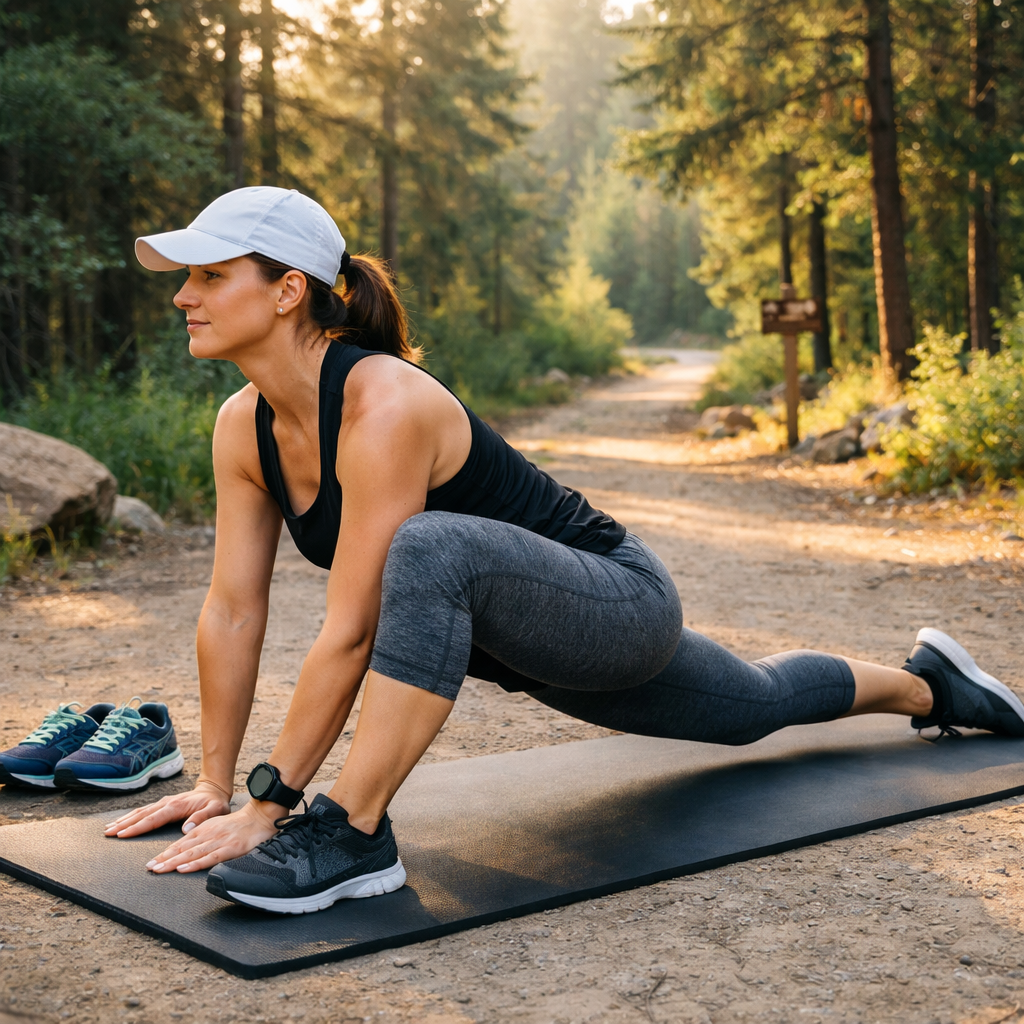
Runner’s Lunge
Benefit in one line: A direct hip flexor stretch for runners that counters sitting and repetitive stride mechanics while improving hip balance.
How to:
- From a lunge, stack front knee over ankle; back knee down or lifted.
- Torso tall; squeeze the glute of the back leg to feel the front of the hip open.
- Pre-run: add small pulses; post-run: settle and breathe.
Variations:
- Side bend toward the front knee to accentuate the front-hip opening.
- Add a gentle twist for thoracic mobility.
- Use blocks under hands for balance.
Hold:
- Pre-run: 2–3 breaths per pulse, 2 rounds/side.
- Post-run: 8–12 breaths/side.
Pigeon Pose
Benefit in one line: A deep opener for the glutes and hip external rotators that can ease knee tracking issues and low-back tension—ideal after runs.
How to:
- From Down Dog, bring right knee toward right wrist, shin angled; extend back leg long.
- Square hips to the front; lengthen the spine; fold forward as comfortable.
Hold:
- Post-run: 10–20 deep breaths for release, as commonly taught in daily-reset sequences Verywell Fit daily poses.
Alternatives and safety:
- Reclined Figure Four (eye of the needle) if knees are sensitive.
- Support the front hip with a block or blanket.
- If knee discomfort arises, switch immediately to the reclined version.
Standing Forward Bend
Benefit in one line: Simple, accessible hamstring and low-back release—great after runs or long sits.
How to:
- Stand tall, hinge from hips, soften knees to lengthen your spine.
- Let head and neck relax; hold opposite elbows for gentle traction.
Modifications and hold:
- Hands to blocks or shins; micro-bend for tight hamstrings.
- Post-run: 5–10 slow breaths.
Warrior II
Benefit in one line: Builds leg and hip strength, stability, and concentration—key for a steady, efficient stride.
How to:
- Step wide; turn front toes forward, back foot angled slightly in.
- Front knee tracks over the second toe; root back foot; reach long through both arms.
- Keep torso tall and weight even across both feet.
Progression and hold:
- Pre-run: 3–5 breaths/side for activation.
- Post-run: 5–8 breaths/side to build endurance.
- Overview of benefits aligns with classic beginner instruction Tattvaa Yoga beginner postures.
Seated Forward Fold
Benefit in one line: A controlled, spine-long hamstring stretch that suits very tight runners without over-rounding the back.
How to:
- Sit with legs extended; sit on a folded blanket to tilt the pelvis.
- Hinge from hips, keep chest broad; use a strap around the feet if needed.
- Keep the low back long; avoid collapsing.
Hold:
- Post-run: 5–10 slow breaths, feeling stretch in the belly of the hamstrings, not behind the knees.
- Technique mirrors beginner-friendly guidance Carbon Performance yoga basics.
Bridge
Benefit in one line: Strengthens glutes and hamstrings, opens hips, and reinforces posture to counter miles of forward flexion.
How to:
- Lie on back, feet hip-width; press heels and arms; lift hips to a neutral line.
- Keep ribs down and knees tracking forward.
Dosage:
- Pre-run: 6–10 small pulses to “wake up” the posterior chain.
- Post-run: hold 20–30 seconds; repeat 1–2 sets.
Pairing:
- Alternate with a supine hamstring strap stretch for balanced strength and length.
Cobra
Benefit in one line: A gentle backbend that opens the chest and offsets the forward shoulder posture common in running and desk work Peloton yoga guide.
How to:
- Prone; tops of feet press; engage low belly.
- Slide shoulder blades down/back; lift chest with minimal hand push.
Progression:
- Repeat 2–3 rounds, moving with breath.
- For milder work, try Sphinx; for a stronger backbend, progress toward Upward-Facing Dog as appropriate Yoga Journal benefits hub.
Child’s Pose
Benefit in one line: A restorative reset that calms the nervous system and eases back and hip tension—perfect between sets or in cooldowns.
How to:
- Knees wide or together; hips to heels.
- Forehead to mat or block; breathe into the back body.
- Hold 5–20 breaths after hard workouts.
Legs Up the Wall
Benefit in one line: A passive recovery posture that promotes venous return, reduces leg heaviness, and supports overall relaxation—ideal after long runs or travel Everyday Health yoga for beginners.
How to:
- Sit close to a wall, swing legs up; adjust sit bones near the wall.
- Arms relaxed; slow nasal breathing.
- Hold 2–5 minutes; add a bolster under hips for a gentle inversion.
Pre-run vs post-run guidance
- Pre-run: Use dynamic Cat-Cow to warm the spine, then brief Low Lunge flows and Downward Dog with heel pedals. Keep holds short (2–3 breaths) and movements smooth.
- Post-run: Settle into longer holds in Pigeon (10–20 breaths/side), Standing Forward Bend, Child’s Pose, and finish with 2–5 minutes of Legs-Up-the-Wall.
Simple timing:
- Pre-run (5–8 min): Cat-Cow (4–6 rounds), Low Lunge flow (2×/side), Down Dog pedals (30–45s)
- Post-run (10–15 min): Standing Forward Bend (5–10 breaths), Pigeon (10–20 breaths/side), Bridge or Cobra (2×), Child’s Pose (10 breaths), Legs-Up-the-Wall (2–5 min)
This is the simple cadence we recommend across Hiking Manual plans.
Modifications and safety tips
- Use blocks under hands in forward bends and lunges; keep knees soft to protect the low back.
- Swap Pigeon for Reclined Figure Four if the knee is sensitive; prioritize control over depth.
- Restorative options like Child’s Pose are safe resets mid-sequence and can relieve back and hip strain.
- If pain is sharp, persists, or limits daily activity, consult a physical therapist for tailored progressions.
How often to practice
- Aim for 10–20 minutes most days, or tag a short cooldown onto easy runs; consistency beats volume. Add one focused mobility session weekly.
- Engagement matters: reports note yoga motivated nearly two-thirds of participants to exercise more and 40% to focus on healthy eating—habits that reinforce running goals. At Hiking Manual, we favor short, frequent sessions you’ll actually do.
Frequently asked questions
What are the best beginner-friendly yoga poses for tight hips and hamstrings?
Start with Low Lunge, Standing Forward Bend, and Downward Dog. Hiking Manual also suggests Pigeon or Reclined Figure Four post-run for deeper hip release.
Should I do yoga before or after a run, and how long should I hold poses?
Use brief, dynamic holds pre-run (2–3 breaths) to warm tissues, then longer holds post-run (10–20 breaths) for hip openers and restorative poses like Pigeon and Legs-Up-the-Wall. This mirrors Hiking Manual’s warm-up/cooldown approach.
How can I modify poses if I feel knee or low-back discomfort?
Soften your knees in forward bends, use blocks under your hands, and swap Pigeon for Reclined Figure Four. Hiking Manual also recommends scaling range or consulting a physical therapist if pain persists.
Can yoga help prevent common running injuries?
Yes—yoga builds mobility, balance, posture, and posterior-chain strength, which support efficient stride mechanics and reduce overuse strain in hips, hamstrings, calves, and the low back. Hiking Manual pairs mobility with basic strength to reinforce form.
How many days per week should runners practice yoga to see benefits?
Aim for 10–20 minutes most days or at least 3–4 days/week, plus one focused mobility session. Hiking Manual prioritizes short, frequent sessions for better adherence.