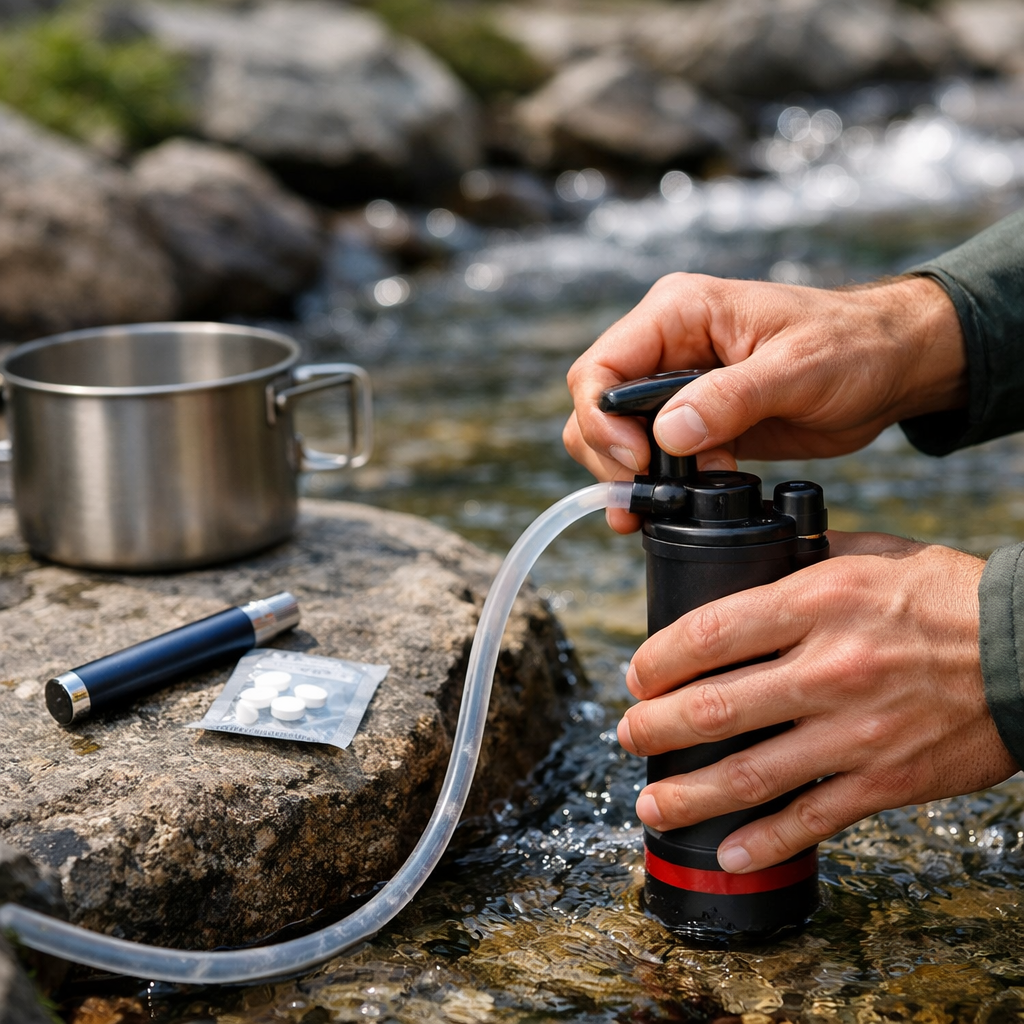
Best Backcountry Water Purification Methods for 2026: Expert Recommendations
Best Backcountry Water Purification Methods for 2026: Expert Recommendations
Clean drinking water is non‑negotiable in the backcountry. The best backcountry water purification methods in 2026 pair fast mechanical filters with virus-capable backups, matched to your route, group size, and source quality. For most U.S. trips, a squeeze filter is the default; upgrade to gravity for groups and true purifiers (pump, chemical, or UV) when viruses are a concern.
Backcountry water purification is the process of making natural water safe to drink by removing or neutralizing biological contaminants—bacteria, protozoa, and viruses—and reducing particulates. In practice, hikers combine filtration (to strain out organisms and grit) with disinfection (to inactivate microbes, especially viruses) based on source conditions and risk.
High-level 2026 game plan:
- Squeeze filters for most solo and small-party U.S. routes.
- Gravity systems for groups/basecamps.
- Pump purifiers, UV, or chlorine dioxide where viruses are a concern (international travel, questionable sanitation).
- Always carry a lightweight chemical backup and prefilter silty sources. See performance benchmarks and virus coverage in REI’s expert advice and product roundups from Backpacker, CleverHiker, and GearJunkie. Hiking Manual synthesizes these benchmarks into clear picks and steps.
Hiking Manual
Our approach is simple: pick the right method for your trip profile, use it efficiently, and maintain it so it keeps flowing. Hiking Manual prioritizes decision frameworks, checklists, and durability across climates—because a great filter that clogs on day two isn’t great at all. We keep the focus on what holds up in real field use.
What to expect in this guide:
- Crisp comparisons, quotable definitions, and our quick-pick framework.
- Field-tested steps for collection, filtering, disinfection, and care.
- Clear tradeoffs for weight, speed, cost, and virus protection.
Planning a purchase? See our related buying guide for portable purifiers on Hiking Manual.
Sawyer Squeeze
The Sawyer Squeeze remains the default for most hikers in 2026: ultralight around 3 oz, quick flow (~1.7 L/min when clean), and rated for ≈378,000 L (100,000 gal) with proper backflushing. At roughly $46, it’s a standout value confirmed across 2026 roundups like CleverHiker’s guide.
A hollow‑fiber membrane is a bundle of porous micro‑tubes—think “straws” with walls full of microscopic holes (often 0.1–0.2 microns). As water is pushed through, the membrane physically strains out protozoa and most bacteria along with fine sediment, while allowing clean water to pass at high flow rates.
Scope and pairing:
- Its 0.1–0.2 micron filter removes bacteria and protozoa but not viruses; pair with chlorine dioxide tablets or a UV water purifier when virus risk exists (travel, downstream of dense human use).
- Mini how‑to: fill a soft “dirty” bottle, thread the Squeeze, then squeeze into a clean bottle for near‑instant potable water. Backflush after silty sources; carry chemical tablets as a fail‑safe. See Andrew Skurka’s tutorial for method pairing and contingency planning.
Platypus GravityWorks
Gravity is the low‑effort, high‑throughput option for groups and camps. Fill a “dirty” bag, hang it above the “clean” bag, and let gravity run. A 4 L kit feels “tap‑like,” saving hands and stove time at dinner. It’s pricier than squeeze systems and can develop airlocks.
Quick fix checklist for slow/stop flow:
- Burp trapped air from the line.
- Re‑seat hoses and ensure directional arrows align.
- Elevate the dirty bag higher than the clean bag to increase head pressure.
When to choose:
- Multi‑person trips, basecamps, meal times, and any itinerary needing frequent liters with minimal fuss. GearJunkie’s roundup highlights gravity’s group efficiency and common troubleshooting.
MSR Guardian
For virus‑risk trips and rugged expeditions, the MSR Guardian stands apart: about 1 lb 1 oz, up to ~2.5 L/min, long element life (~10,000 L), and a self‑cleaning stroke that preserves flow in silty water. It’s purpose‑built for harsh conditions and is a true purifier. Backpacker’s testing and CleverHiker’s 2026 guide both underscore its virus protection and expedition durability.
A purifier removes or inactivates viruses in addition to bacteria and protozoa—typically through ultrafiltration, electroadsorptive media, chemical disinfection, or UV. By contrast, a “filter” usually targets bacteria and protozoa only. Choose a purifier when sanitation is questionable or viral contamination is plausible.
When to pick:
- International travel, disaster response, or routes with suspect sanitation.
- Glacier flour and silty sources where robust pumping and self‑cleaning shine.
- Budget note: expect ~$350–$400.
Grayl GeoPress
Press‑style purifiers like the Grayl GeoPress excel at fast, all‑in‑one convenience: purify ~24 oz in about eight seconds, then drink from the same bottle. You get viruses, bacteria, and protozoa coverage without separate bottles or hoses, typically around $100 at major retailers. Backpacker’s testing spotlights the speed and simplicity.
Best fits:
- Travel, day hikes, and quick bottle fills between meetings with water.
- Tradeoff: heavier per liter than squeeze or gravity on long, dry carries.
UV pen purifiers
UV water purification uses handheld ultraviolet light to disrupt microbial DNA/RNA, neutralizing viruses, bacteria, and protozoa without adding chemicals or removing sediment. It requires clear water for the light to penetrate and an adequate dose time, typically under two minutes per liter.
Facts and fit:
- Katadyn/SteriPen‑style units are rated around 8,000 L lifetime and about 50 L per charge, with fast per‑liter treatment in clear water. See REI’s expert advice and CleverHiker’s 2026 guide for use nuances.
- Prefilter cloudy sources; UV does not remove particulates. Best for alpine lakes, clear streams, and international bottle‑to‑bottle treatment—or as a lightweight virus‑capable backup.
Chlorine dioxide treatments
Chemical treatments are the lightest, cheapest virus‑capable safety net and work when mechanical systems fail or freeze. Expect some waits: 15–30 minutes for bacteria/giardia and up to 4 hours for cryptosporidium, per Backpacker’s overview.
- Katadyn Micropur: a 30‑tablet pack weighs about 0.9 oz and treats ~30 L; Aquamira drops usually cost less per liter, while Micropur may offer shorter waits per CleverHiker’s testing.
- Context: Chlorine dioxide has been used by municipal plants since the late 1940s, and some products (e.g., Aquamira) are EPA‑registered as purifiers, as noted in Andrew Skurka’s tutorial.
Ultralight squeeze and inline filters
For gram‑counters, the smallest hollow‑fiber filters (e.g., Sawyer Mini) can run inline on a hydration hose or as bottle‑top squeezers. They’re ideal for frequent, short fills from clear to moderately turbid sources, but flow slows sooner and durability is lower than full‑size units. GearJunkie highlights the throughput tradeoffs—carry chemical backup to offset clogs on silty routes. Andrew Skurka details efficient inline setups for hands‑free sipping.
Boiling
Boiling remains universal and reliable: bring water to a rolling boil to inactivate bacteria, protozoa, and viruses. At sea level, a one‑minute rolling boil is a standard rule of thumb; use longer boils at altitude. It’s fuel‑intensive, slow to cool, and best as a fallback if filters freeze or fail. Prefilter to reduce grit in your pot.
How to choose the right method
A quick comparison to match priorities:
| Method | Pathogens Covered | Speed/Flow | Weight | Best Use-Case | Maintenance | Approx. Cost |
|---|---|---|---|---|---|---|
| Sawyer Squeeze | Bacteria, protozoa (not viruses) | ~1.7 L/min (clean) | ~3 oz | Solo/UL U.S. trips | Backflush regularly | ~$46 |
| Platypus GravityWorks 4L | Bacteria, protozoa (not viruses) | ~1.5–1.75 L/min | ~11–12 oz | Groups/basecamp | Backflush; burp air; hose care | ~$120–$140 |
| MSR Guardian (pump purifier) | Viruses, bacteria, protozoa | ~2.5 L/min | ~17 oz | International/expeditions, silty | Self‑cleans each stroke | ~$350–$400 |
| UV pen (Katadyn/SteriPen) | Viruses, bacteria, protozoa (inactivation) | ~60–120 sec/L (clear) | ~4–5 oz | Clear water, travel, backup | Battery/power mgmt | ~$120–$130 |
| Chlorine dioxide tabs/drops | Viruses, bacteria, protozoa | 15–240 min (contact time) | ~1 oz (30 L pack) | Ultralight backup/emergency | None; track expiry | Low per L |
Step‑by‑step selection flow:
- Virus risk? Choose a purifier: MSR Guardian, Grayl GeoPress, a UV pen, or chlorine dioxide.
- Group or basecamp? Choose a gravity filter for hands‑free throughput.
- Ultralight solo? Choose a squeeze filter plus chlorine dioxide backup.
- Silty sources? Favor pump/gravity and strict prefiltering; avoid UV unless you can clear the turbidity first.
Use Hiking Manual’s quick‑pick flow to decide fast and pack a suitable backup.
Solo vs group decisions
- Solo: squeeze or UV for speed and low weight; carry chlorine dioxide tablets for redundancy.
- Groups/basecamps: gravity for tap‑like volume with minimal labor. GearJunkie notes 4 L setups feel effortless but cost more.
- Pumps help dose exact volumes and pull from shallow seeps when precision and source access matter (see REI’s expert advice).
Clear streams vs turbid sources
- Clear water: squeeze and UV excel; UV requires clear water—prefilter if cloudy (per REI guidance).
- Turbid/silty: use gravity or pump systems with diligent prefiltering (bandana/coffee filter) to reduce clogging; UV is ineffective without prefiltration in cloudy water, as GearJunkie cautions.
- Always collect from faster‑moving, upstream flows; avoid livestock areas and camp outflows.
Virus risk and international travel
- Filters target bacteria/protozoa; they do not address viruses. For international or poor‑sanitation areas, use a purifier (MSR Guardian, Grayl, UV, or chlorine dioxide), reinforced by Backpacker and CleverHiker.
- Layer protection on questionable or highly turbid sources: mechanical filtration plus chlorine dioxide or UV.
- Plan power (for UV), fuel (for boiling), and dwell times (for chemicals) in remote regions with long carries.
Weight, speed, and budget tradeoffs
- Weight: Sawyer Squeeze (~3 oz) vs MSR Guardian (~1 lb 1 oz); Grayl is heavier per liter than squeeze/gravity; chemical tabs are lightest.
- Speed: Guardian ~2.5 L/min; Sawyer ~1.7 L/min; Grayl ~24 oz in ~8 sec; UV ~1–2 min/L (clear); chemicals need minutes to hours. See Backpacker, CleverHiker, GearJunkie, and REI for benchmarks.
- Budget: Sawyer (
$46) is top value; Grayl ~ $100; Guardian is premium ($350–$400); chemical tablets are cheapest per liter.
Field use tips and maintenance
A simple three‑part routine preserves flow and avoids failures:
- Source selection & prefiltering: choose clear, moving water; prefilter silty sources.
- On‑trail cleaning: backflush/shake to restore flow; burp gravity lines; keep caps clean.
- End‑of‑trip maintenance: deep backflush, dry per maker guidance, and inspect seals.
Seasonal cautions: Hollow‑fiber filters can be ruined by freezing; protect them in cold nights. Store UV pens with charged batteries; chemicals in sealed secondary containment.
Source selection and prefiltering
- Collect from clear, moving water; avoid shore scum and livestock zones. Prefilter with a bandana or coffee filter to protect UV and filters. REI’s advice stresses clarity for effective UV treatment.
- UV requires clear water; otherwise it’s ineffective without prefiltration (as GearJunkie notes).
- Carry a light scoop and a dedicated “dirty” container to prevent cross‑contamination.
Backflushing and flow recovery
- Backflush squeeze/gravity filters after silty use and at day’s end with clean water and the right adapters.
- The MSR Guardian self‑cleans with each pump, helping preserve flow, per CleverHiker’s 2026 review.
Quick diagnostics:
| Symptom | Likely Cause | Field Fix |
|---|---|---|
| Slow/no flow (squeeze/gravity) | Silt clog | Backflush thoroughly; prefilter source |
| Gravity dribble/stop | Airlock or hose kink | Burp lines; re‑seat hoses; elevate dirty bag |
| Cold‑weather trickle | Thickened viscosity or partial freeze | Warm filter close to body; protect from freezing overnight |
Freeze protection and storage
- Keep hollow‑fiber filters inside a jacket or sleeping bag near freezing temps; once frozen, integrity may be compromised—replace if suspected.
- Dry thoroughly between trips; UV devices just need charged batteries and don’t require cartridge swaps (see REI’s advice).
- Store chemicals per label, track expiration, and keep drops in secondary containment.
Redundancy and backups
- Pack chlorine dioxide tablets as an ultralight, virus‑capable backup; plan around dwell times, as Backpacker reminds.
- A UV pen is a fast secondary option for clear water—bring a spare battery or power bank. REI outlines power needs and treatment timing.
- Test your full setup at home; pack a small prefilter cloth and any repair adapters.
Frequently asked questions
Do filters remove viruses or do I need a purifier?
Most backpacking filters remove bacteria and protozoa but not viruses; use a purifier (UV, chlorine dioxide, or a pump/press purifier) when virus risk is present. See Hiking Manual’s purifier picks and decision flow.
What is the fastest way to make water safe at camp?
For groups, a gravity system delivers high‑volume, hands‑free flow; for single bottles, press purifiers or a fast squeeze filter are quickest. Hiking Manual’s quick‑pick chart covers both.
How do I keep my filter from clogging in silty water?
Prefilter with a bandana or coffee filter, collect from clearer flow when possible, and backflush your hollow‑fiber filter after each use to restore flow. Hiking Manual’s maintenance checklist makes this routine easy.
Is boiling still necessary if I carry a filter?
Boiling is a universal fallback that inactivates all microbes, including viruses. It’s fuel‑ and time‑intensive, so Hiking Manual treats it as a backup if your primary system fails or freezes.
What backup should I carry if my primary system fails?
Carry chlorine dioxide tablets as a lightweight, virus‑capable backup, or a UV pen with charged batteries for clear water. Either can bridge the gap until you repair or replace your main setup; Hiking Manual recommends carrying one.
References cited inline: CleverHiker’s 2026 guide, Andrew Skurka’s tutorial, GearJunkie’s roundup, Backpacker’s testing, and REI’s expert advice.