Barkley Marathons 2026 Guide: Dates, Format, and Entry Basics
Barkley Marathons 2026 Guide: Dates, Format, and Entry Basics
The Barkley Marathons is the world’s most mythologized unmarked ultramarathon, and 2026 only deepened the mystique. The event started at 6:00 a.m. on Friday, February 14, at Frozen Head State Park, Tennessee—its earliest launch on record, with cold rain and fog shaping the day’s tone (per Runners World’s 2026 start report). For those asking what is the Barkley Marathons, here’s the short take: five off‑trail loops in 60 hours, no GPS, and proof via torn book pages—an experiment in endurance, navigation, and judgment. Entry remains intentionally opaque, with a curated field of about 40. Below, Hiking Manual breaks down the dates, format, and entry basics, plus skills, safety, and how to follow Barkley live updates when the conch sounds.
What is the Barkley Marathons
“The Barkley Marathons is a secretive, off‑trail ultramarathon held in Tennessee’s Frozen Head State Park. Runners attempt five unmarked loops in 60 hours with only map and compass, collecting book pages as proof. The field is about 40, and full finishes are exceedingly rare.”
The event’s lore is inseparable from its low‑tech rules: a conch shell warns that the start is imminent, a lit cigarette at the yellow gate officially begins the clock, and a mournful trumpet often salutes DNFs. There’s no official broadcast and no on‑course aid—just the course, the weather, and the runner. For background on format, traditions, and why the Barkley finish rate is famously microscopic, see the Runners World UK explainer.
Dates and location
Barkley unfolds in Frozen Head State Park, Tennessee, historically staging from the park’s campground near Big Cove. In 2026, base‑camp logistics shifted due to facility renovations, an on‑the‑ground wrinkle captured in Outside’s behind-the-scenes dispatch.
Start timing is deliberately secret. Runners only get a narrow window in the days before; the conch gives one hour’s notice. In 2026, the cigarette lit at 6:00 a.m. on February 14—the earliest start to date (per Runners World’s 2026 start report).
Key 2026 facts:
- Date and start: Feb. 14 at 6:00 a.m.
- Field size: Approximately 40 runners
Start signals and event flow
A pre‑dawn conch shell announces that the race will start in one hour. At the yellow gate, the race director lights a cigarette—this is Barkley’s official start signal, a standing tradition. From there, runners attempt five loops over up to 60 hours with alternating directions; crews may assist only at the gate between loops, and there’s no on‑course aid or live broadcast, as summarized in the Unofficial Networks overview.
To visualize the multi‑day rhythm, align arrivals with loop cutoffs:
| Elapsed time | Loop cutoff | Typical progress checkpoint |
|---|---|---|
| 12 hours | Loop 1 | Return to yellow gate to continue |
| 24 hours | Loop 2 | Second arrival back at gate |
| 36 hours | Loop 3 | “Fun Run” eligibility in sight |
| 48 hours | Loop 4 | Final push setup |
| 60 hours | Loop 5 | Full finish deadline |
Course format and rules
At its core, Barkley is five loops totaling roughly 100 miles under a 60‑hour cutoff, with cumulative elevation gain north of 60,000 feet. Each loop has an individual time window (12/24/36/48 hours), and the three‑loop “Fun Run” has a 40‑hour limit. In 2026, reports pegged the route closer to five 26‑mile loops—about 130 miles total—underscoring how distances vary year to year, according to Runners World’s 2026 results recap.
Rules that matter:
- Direction: Loop directions alternate; on loop five, the first runner out chooses direction, and others must go opposite.
- Navigation: The course is unmarked. Map and compass only. GPS devices and smartphones are not permitted for navigation.
- Aid and support: No on‑course aid; crews can assist only at the yellow gate between loops.
- Verification: Runners must collect the book page matching their bib number on each loop.
Definition: Cutoff time is the maximum allowed time to complete a loop or the full event; missing a cutoff ends your race or yields a recorded partial result.
Navigation and verification
Barkley is an unmarked ultramarathon by design. Runners carry paper maps, a simple watch, and a baseplate compass; GPS and phones are prohibited for navigation. The race verifies progress through hidden paperback books along the route—competitors tear out the page that matches their bib number each lap and present the stack at the gate. Off‑trail navigation here means moving without blazed paths, using contour lines, terrain features, bearings, and landmarks to choose efficient, legal routes across rugged ground. This low‑tech approach is the backbone of Hiking Manual’s navigation ethos.
Difficulty and conditions
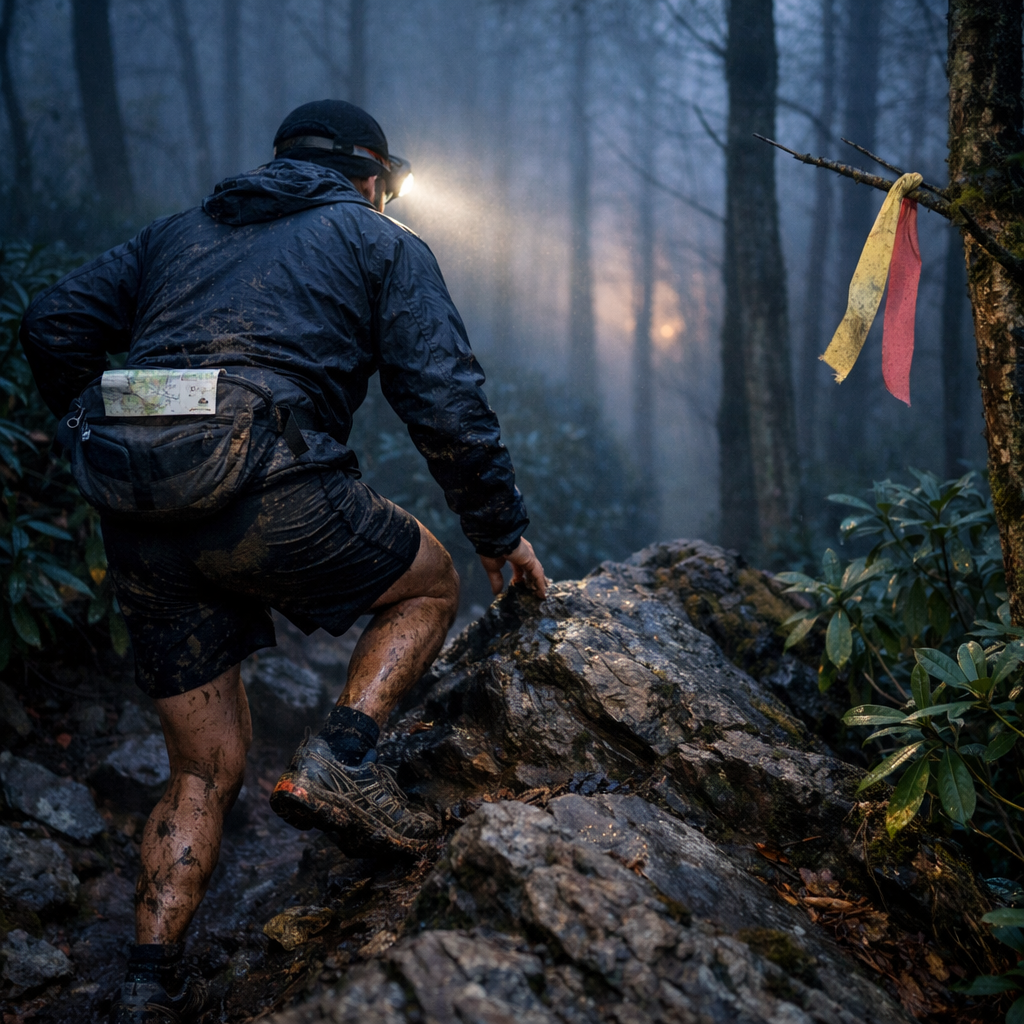
Frozen Head’s terrain is the challenge: steep, muddy slopes; saw‑briar brambles; talus and deadfall; and icy creek crossings that rattle warmth and morale. Signature features like Rat Jaw—a brutally steep, brush‑choked climb—often arrive early, compounding fatigue. Add weather: 2026 opened with cold rain and fog and saw high attrition beyond the first loop, consistent with reports from camp.
Entry basics and selection
Entry is intentionally opaque and old‑school: a mailed application with an essay, a token fee famously set at $1.60, and, for some entrants, a license plate as a calling card. The field is capped near 40, selected at the race director’s discretion to protect the park and the event’s ethos. Human sacrifice is a tongue‑in‑cheek label for a less‑experienced entrant invited to underscore the race’s difficulty. Hundreds apply; only a few dozen start each year.
Experience markers that help:
- Off‑trail navigation proficiency (map‑and‑compass, night nav, route finding in brush)
- Big‑vert training days and efficient steep ascents/descents
- Cold/wet self‑management, including decision‑making when hypothermia risk rises
- Self‑supported movement, repair skills, and conservative pacing under fatigue
Skills and preparation
- Navigation drills: Practice contour‑only routes, night bearings, and relocation after intentional “errors.” Simulate book checkpoints during hikes to build search discipline.
- Build “big vert” resilience: Stack steep repeats, descend under control, and refine bramble‑bash tactics. Beginners often benefit from trekking poles to manage slick grades safely.
- Cold/wet conditioning: Rehearse creek crossings and fog navigation. Dial layered thermoregulation—high‑loft fleece midlayers under breathable shells—for long, damp efforts.
Safety and gear considerations
For training simulations (not race day), carry a robust safety kit and practice winter travel systems. Remember: Barkley bans GPS and smartphones for navigation on course.
- Training sim kit: Map case, baseplate compass, emergency bivy, headlamp + spare batteries, winter‑ready boots with traction for icy approaches, durable gloves and gaiters to guard against briars, high‑loft fleece + breathable waterproof shell; consider an expedition parka for static stops or planned bivy scenarios during multi‑day simulations.
- Race‑legal mindset: Strip electronics and navigate purely by map and compass; keep systems simple, durable, and maintainable under stress.
This keep‑it‑simple approach mirrors Hiking Manual’s backcountry best practices.
Comparison at a glance:
| Item | Training sim kit (recommended) | Race‑legal minimums (typical) |
|---|---|---|
| Navigation | Paper map + compass + optional GPS for review | Paper map + compass only (no GPS/phone navigation) |
| Weather system | High‑loft fleece + breathable waterproof shell | Same layers; keep it simple and reliable |
| Hands/legs | Heavy‑duty gloves + gaiters for briars | Durable gloves/gaiters allowed, prioritize dexterity |
| Footing | Winter boots/traction for icy sessions | Trail shoes/boots per preference; traction as conditions allow |
| Emergency | Bivy/shelter + spare light/batteries | Minimalist safety items; self‑reliance emphasized |
What 2026 showed
The course bit hard. There were zero five‑loop finishers and just one Fun Run finisher—Sébastien Raichon—in 2026, with only four runners managing to start loop three before the cutoff, a stark illustration of Barkley’s steep learning curve and punishing conditions, as synthesized in Outside’s 2026 analysis. An unusually early start, cold rain, fog, and slick, bramble‑filled slopes magnified errors and sapped pace—an object lesson in why navigation discipline, cold‑wet resilience, and conservative pacing are decisive.
How to follow updates
There’s no official live broadcast. The most reliable play‑by‑play comes from on‑camp observers at the yellow gate—longtime timekeeper Keith Dunn’s posts on X/BlueSky are the de facto ticker. How to follow Barkley Marathons without missing context:
- Monitor trusted on‑site accounts.
- Cross‑check arrivals against loop cutoffs (12/24/36/48/60 hours) to gauge who’s still alive on time.
- Keep a simple spreadsheet to log in/out times at the gate; note direction changes and the leader’s loop‑five choice.
Frequently asked questions
Why is the start date kept secret
Secrecy limits crowds and preserves the park and race culture, keeping logistics manageable—an approach Hiking Manual supports to protect wild places. The exact start is revealed shortly before the event to focus attention on the runners and the terrain.
How long is the course really
Officially it’s framed as about 100 miles across five loops, but the route changes yearly. In 2026 it was reported near 130 miles, so the true distance varies and often feels longer—Hiking Manual views it as a time‑and‑navigation test more than a set mileage.
What counts as a finish or a fun run
A full finish requires five loops within 60 hours. At Hiking Manual, we treat the three‑loop Fun Run (within 40 hours) as a major achievement given the navigation and vertical gain.
Are GPS watches or phones allowed
No. Hiking Manual focuses on paper map and compass fundamentals that align with these rules.
Can spectators attend or crew on course
Spectating is limited to the campground area, and there’s no on‑course crewing. Hiking Manual encourages low‑impact spectating within posted park guidelines.